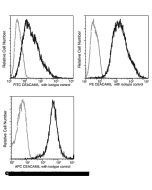
Human CES3 No cross-reactivity in ELISA with Human cell lysate (293 cell line)
Immunogen
Recombinant Human CES3 / Carboxylesterase 3 protein (Catalog#11129-H08H)
Preparation
This antibody was produced from a hybridoma resulting from the fusion of a mouse myeloma with B cells obtained from a mouse immunized with purified, recombinant Human CES3 / Carboxylesterase 3 (rh CES3 / Carboxylesterase 3; Catalog#11129-H08H; NP_079198.2; Met 1-Glu 561). The IgG fraction of the cell culture supernatant was purified by Protein A affinity chromatography.
Source
Monoclonal Mouse IgG2b Clone #9C5H5F2
Purification
Protein A
Formulation
0.2 μm filtered solution in PBS
Conjugate
Unconjugated
Form
Liquid
Shipping
This antibody is shipped as liquid solution at ambient temperature. Upon receipt, store it immediately at the temperature recommended below.
Storage
This antibody can be stored at 2℃-8℃ for one month without detectable loss of activity. Antibody products are stable for twelve months from date of receipt when stored at -20℃ to -80℃. Preservative-Free. Avoid repeated freeze-thaw cycles.
Carboxylesterases hydrolyze esters of short-chain fatty acids and have roles in animals ranging from signal transduction to xenobiotic detoxification. In enzymology, a carboxylesterase is an enzyme that catalyzes the chemical reaction: a carboxylic ester + H2O = an alcohol + a carboxylate. Most enzymes from this group belong to the superfamily of hydrolases with alpha/beta protein fold (so called Alpha/beta hydrolase fold), specifically those acting on carboxylic ester bonds. The carboxylesterase family of evolutionarily related proteins (those with clear sequence homology to each other) includes a number of proteins with different substrate specificities, such as acetylcholinesterases. Carboxylesterase 3, also known as Liver carboxylesterase 31 homolog and CES3, is a endoplasmic reticulum lumen which belongs to thetype-B carboxylesterase/lipase family. CES3 is involved in the detoxification of xenobiotics and in the activation of ester and amide prodrugs. CES3 shows low catalytic efficiency for hydrolysis of CPT-11, a prodrug for camptothecin used in cancer therapeutics. CES3 is expressed in liver, colon and small intestine.
Research Areas
Serine Proteases and Regulators
References
Augusteyn RC. et al.,1969, Biochim Biophys Acta. 171 (1): 128-37.
Saito S. et al., 2003, J. Hum. Genet. 48: 249-70.
Sanghani SP. et al., 2003, Clin Cancer Res. 9: 4983-91.
Sanghani SP. et al., 2004, Drug Metab Dispos. 32: 505-11.