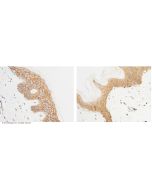
Human Factor H-related 2/CFHR2 Has cross-reactivity in ELISA with Human CFHR1 No cross-reactivity in ELISA with Human cell lysate (293 cell line)
Immunogen
Recombinant Human CFHR2 protein (Catalog#13920-H08H)
Preparation
This antibody was produced from a hybridoma resulting from the fusion of a mouse myeloma with B cells obtained from a mouse immunized with purified, recombinant Human CFHR2 (rh CFHR2 ; Catalog#13920-H08H; P36980-1; Met1-Lys270). The IgG fraction of the cell culture supernatant was purified by Protein A affinity chromatography.
Source
Monoclonal Mouse IgG1 Clone #01
Purification
Protein A
Formulation
0.2 μm filtered solution in PBS
Conjugate
Unconjugated
Form
Liquid
Shipping
This antibody is shipped as liquid solution at ambient temperature. Upon receipt, store it immediately at the temperature recommended below.
Storage
This antibody can be stored at 2℃-8℃ for one month without detectable loss of activity. Antibody products are stable for twelve months from date of receipt when stored at -20℃ to -80℃. Preservative-Free. Avoid repeated freeze-thaw cycles.
CFHR2 belongs to the complement factor H protein family. The human complement factor H protein family consists of the complement and immune regulators factor H, the factor H-like protein 1(FHL-1) and five factor H-related proteins (CFHR-1 to -5). Members of the H-related protein family are exclusively composed of individually folded protein domains, termed short consensus repeats (SCRs) or complement control modules. CFHR2 contains 4 Sushi (CCP/SCR) domains and is expressed by the liver and secreted in plasma. CFHR2 might be involved in complement regulation. It can associate with lipoproteins and may play a role in lipid metabolism.
Research Areas
Serine Proteases and Regulators
References
Skerka C, et al. (1991) Molecular cloning of a human serum protein structurally related to complement factor H. J Biol Chem. 266(18):12015-20.
Daz-Guilln MA, et al. (1999) A radiation hybrid map of complement factor H and factor H-related genes. Immunogenetics. 49(6):549-52.
Strausberg RL, et al. (2003) Generation and initial analysis of more than 15,000 full-length human and mouse cDNA sequences. Proc Natl Acad Sci. 99(26):16899-903.