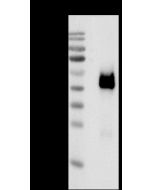
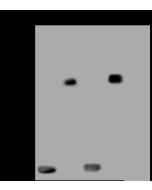
Recombinant Human CRTAM protein (Catalog#11975-H08H)
Preparation
Produced in rabbits immunized with purified, recombinant Human CRTAM (rh CRTAM; Catalog#11975-H08H; NP_062550.2; Met 1-Ser 286). CRTAM specific IgG was purified by human CRTAM affinity chromatography .
Source
Polyclonal Rabbit IgG
Purification
Protein A & Antigen Affinity
Formulation
0.2 μm filtered solution in PBS
Conjugate
Unconjugated
Form
Liquid
Shipping
This antibody is shipped as liquid solution at ambient temperature. Upon receipt, store it immediately at the temperature recommended below.
Storage
This antibody can be stored at 2℃-8℃ for one month without detectable loss of activity. Antibody products are stable for twelve months from date of receipt when stored at -20℃ to -80℃. Preservative-Free. Avoid repeated freeze-thaw cycles.
Synonyms: Anti-CD355 Antibody
Background Information
Full Name
cytotoxic and regulatory T cell molecule
Description
Cytotoxic and regulatory T-cell molecule, also known as Class-I MHC-restricted T-cell-associated molecule and CRTAM, is a single-pass type I membrane protein which belongs to thenectin family.CRTAM contains oneIg-like C2-type (immunoglobulin-like) domain and oneIg-like V-type (immunoglobulin-like) domain. In the immune system, the expression of CRTAM is restricted to activated class-I MHC-restricted cells, including NKT and CD8 cells. It is strongly expressed in spleen, thymus, small intestine, peripheral blood leukocyte, and in purkinje neurons in cerebellum. It is expressed at much lower levels in testis, ovary, colon, lung and lymphoid tissues. CRTAM is a member of the immunoglobulin superfamily that complies with the structural characteristics of the JAM family of proteins and is phylogenetically more closely related to nectin-like proteins. It is a molecule involved in epithelial cell adhesion. CRTAM is sensitive to intermediate filament disruption and treatment of monolayers with soluble CRTAM enhances cell-cell dissociation and lowers transepithelial electrical resistance. CRTAM may also induce retention by binding to CD8+ dendritic cells (DCs) at the late stage of activation before proliferation.
References
Garay, E. et al., 2010, J Cell Biochem. 111 (1):111-22.
Medina-C.O. et al., 2010, Dev Comp Immunol. 34 (2):196-202.
Takeuchi, A. et al., 2009, J Immunol.183 (7):4220-8.
Valle-Rios,R. et al., 2009, Mol Immunol. 46 (16): 3379-87.