A synthetic peptide corresponding to the N-terminus of the Human DHTKD1
Preparation
Produced in rabbits immunized with a synthetic peptide corresponding to the N-terminus of the Human DHTKD1, and purified by antigen affinity chromatography.
Source
Polyclonal Rabbit IgG
Purification
Protein A & Antigen Affinity
Formulation
0.2 μm filtered solution in PBS
Conjugate
Unconjugated
Form
Liquid
Shipping
This antibody is shipped as liquid solution at ambient temperature. Upon receipt, store it immediately at the temperature recommended below.
Storage
This antibody can be stored at 2℃-8℃ for one month without detectable loss of activity. Antibody products are stable for twelve months from date of receipt when stored at -20℃ to -80℃. Preservative-Free. Avoid repeated freeze-thaw cycles.
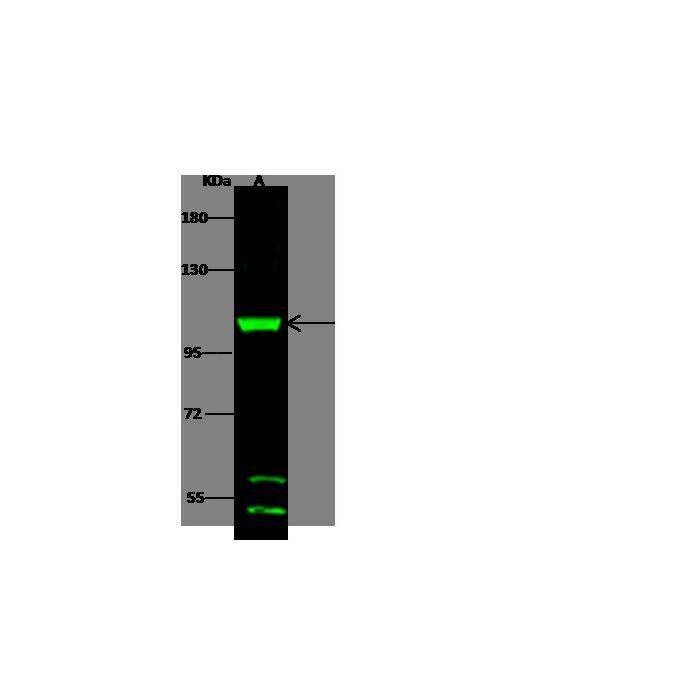
Anti-DHTKD1 rabbit polyclonal antibody at 1:500 dilution Lane A: A431 Whole Cell Lysate Lysates/proteins at 30 μg per lane. Secondary Goat Anti- Rabbit IgG H&L (Dylight 800) at 1/10000 dilution. Developed using the Odyssey technique. Performed under reducing conditions. Predicted band size:103 kDa Observed band size:105 kDa
Anti-DHTKD1 rabbit polyclonal antibody at 1:500 dilution Lane A: A431 Whole Cell Lysate Lysates/proteins at 30 μg per lane. Secondary Goat Anti- Rabbit IgG H&L (Dylight 800) at 1/10000 dilution. Developed using the Odyssey technique. Performed under reducing conditions. Predicted band size:103 kDa Observed band size:105 kDa
dehydrogenase E1 and transketolase domain containing 1
Description
DHTKD1, a part of 2-ketoadipic acid dehydrogenase complex, is involved in lysine and tryptophan catabolism. Mutations in DHTKD1 block the metabolic pathway and cause 2-aminoadipic and 2-oxoadipic aciduria (AMOXAD), an autosomal recessive inborn metabolic disorder. The mutations in dehydrogenase E1 and transketolase domain-containing 1 (DHTKD1), a mitochondrial protein encoding gene, could cause neurological abnormalities

-HD10FE1602-WB.png)
-HD10FE1602-IP.png)