Human Mouse (Species predicted to react based on 100% sequence homology)
Immunogen
A synthetic peptide corresponding to the center region of the Human DROSHA
Preparation
Produced in rabbits immunized with a synthetic peptide corresponding to the center region of the Human DROSHA, and purified by antigen affinity chromatography.
Source
Polyclonal Rabbit IgG
Purification
Protein A & Antigen Affinity
Formulation
0.2 μm filtered solution in PBS
Conjugate
Unconjugated
Form
Liquid
Shipping
This antibody is shipped as liquid solution at ambient temperature. Upon receipt, store it immediately at the temperature recommended below.
Storage
This antibody can be stored at 2℃-8℃ for one month without detectable loss of activity. Antibody products are stable for twelve months from date of receipt when stored at -20℃ to -80℃. Preservative-Free. Avoid repeated freeze-thaw cycles.
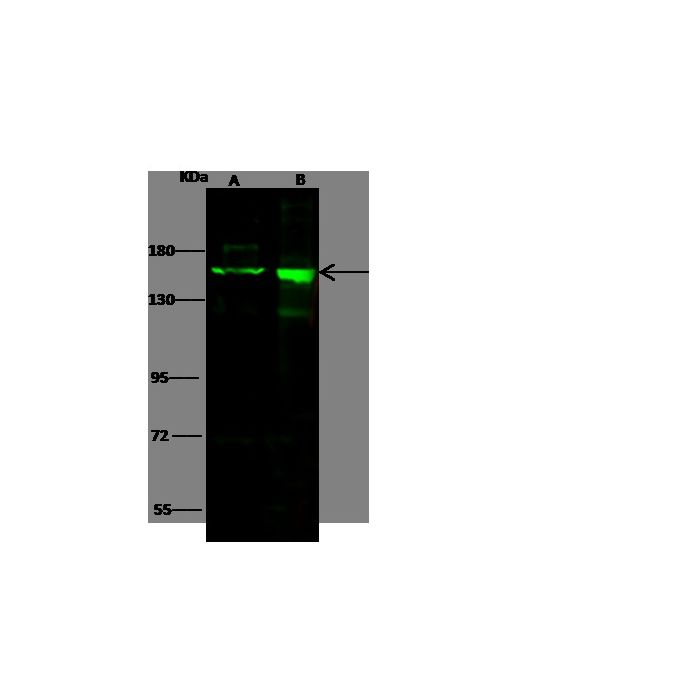
Anti-Drosha rabbit polyclonal antibody at 1:500 dilution Lane A: Jurkat Whole Cell Lysate Lane B: 293 Whole Cell Lysate Lysates/proteins at 30 μg per lane. Secondary Goat Anti- Rabbit IgG H&L (Dylight 800) at 1/10000 dilution. Developed using the Odyssey technique. Performed under reducing conditions. Predicted band size:159 kDa Observed band size:159 kDa (We are unsure as to the identity of these extra bands.)
Both DICER and DROSHA are RNase III enzymes involved in the biogenesis of small non-coding RNAs. DROSHA cleaves the stem-loop portion of the primary miRNAs and produces precursor miRNAs in the nucleus, whereas DICER processes double-stranded RNA precursors into mature miRNAs and endogenous small interference RNAs in the cytoplasm. MicroRNA (miRNA) maturation is initiated by DROSHA, a double-stranded RNA (dsRNA)-specific RNase III enzyme. By cleaving primary miRNAs (pri-miRNAs) at specific positions, DROSHA serves as a main determinant of miRNA sequences and a highly selective gatekeeper for the canonical miRNA pathway. DROSHA is the catalytic subunit of the Microprocessor complex, which initiates microRNA (miRNA) maturation in the nucleus by recognizing and cleaving hairpin precursors embedded in primary transcripts.


-HD09SE0913-WB.png)