Recombinant Human RCAS1 / EBAG9 Protein (Catalog#14012-H07E)
Preparation
This antibody was obtained from a rabbit immunized with purified, recombinant Human RCAS1 / EBAG9 (rh RCAS1 / EBAG9; Catalog#14012-H07E; O00559; Arg28-Ser213).
Source
Monoclonal Rabbit IgG Clone #019
Purification
Protein A
Formulation
0.2 μm filtered solution in PBS
Conjugate
Unconjugated
Form
Liquid
Shipping
This antibody is shipped as liquid solution at ambient temperature. Upon receipt, store it immediately at the temperature recommended below.
Storage
This antibody can be stored at 2℃-8℃ for one month without detectable loss of activity. Antibody products are stable for twelve months from date of receipt when stored at -20℃ to -80℃. Preservative-Free. Avoid repeated freeze-thaw cycles.
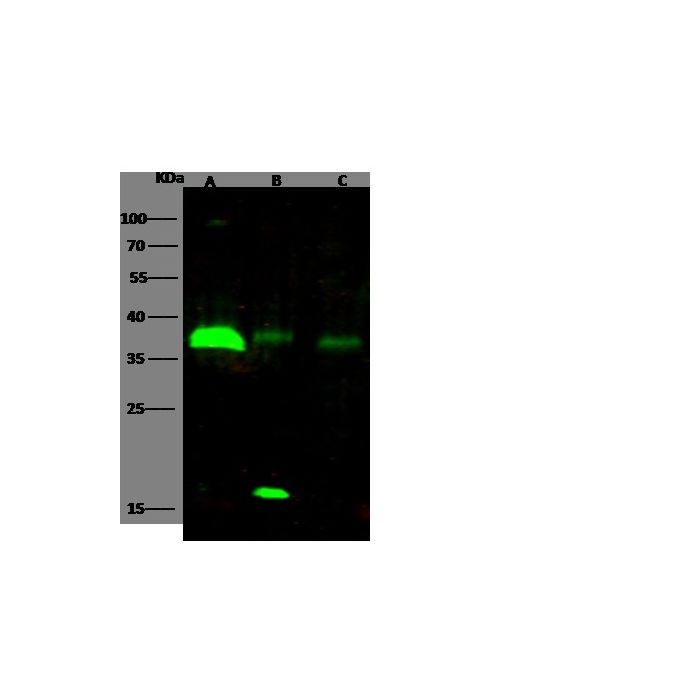
Anti-EBAG9 rabbit monoclonal antibody at 1:500 dilution Lane A: Hela Whole Cell Lysate Lane B: MCF7 Whole Cell Lysate Lane C: A431 Whole Cell Lysate Lysates/proteins at 30 μg per lane. Secondary Goat Anti-Rabbit IgG H&L (Dylight800) at 1/10000 dilution. Developed using the Odyssey technique. Performed under reducing conditions. Predicted band size:24 kDa Observed band size:37 kDa (We are unsure as to the identity of these extra bands.)
estrogen receptor binding site associated, antigen, 9
Description
RCAS1, also known as EBAG9, is a tumor-associated antigen that is expressed at high frequency in a variety of cancers. RCAS1 gene was identified as an estrogen-responsive gene. Regulation of transcription by estrogen is mediated by estrogen receptor which binds to the estrogen-responsive element (ERE) found in the 5'-flanking region of RCAS1 gene. Two transcript variants differing in the 5' UTR, but encoding the same protein, have been identified for RCAS1 gene. EBAG9 may participate in suppression of cell proliferation and induces apoptotic cell death through activation of interleukin-1-beta converting enzyme (ICE)-like proteases.
References
Ohshima K. et al., 2001, Clin Exp Immunol. 123 (3): 481-6.
Ikeda K. et al., 2000, Biochem Biophys Res Commun. 273 (2): 654-60.
Nakashima M. et al., 1999, Nat Med. 5 (8): 938-42.