Recombinant Human EpCAM / TROP-1 / TACSTD1 protein (Catalog#10694-H08H)
Preparation
This antibody was produced from a hybridoma resulting from the fusion of a mouse myeloma with B cells obtained from a mouse immunized with purified, recombinant Human EpCAM / TROP-1 / TACSTD1 (rh EpCAM / TROP-1 / TACSTD1; Catalog#10694-H08H; NP_002345.1; Met1-Lys265) and conjugated with APC under optimum conditions, the unreacted APC was removed.
Source
Monoclonal Mouse IgG1 Clone #06
Purification
Protein A
Formulation
PBS solution containing 0.5% BSA and 0.03%ProClin300
Concentration
5 μl/Test, 0.1 mg/ml
Conjugate
APC
Form
Liquid
Shipping
This antibody is shipped as liquid solution at ambient temperature. Upon receipt, store it immediately at the temperature recommended below.
Storage
This antibody can be stored at 2℃-8℃ for twelve months without detectable loss of activity. Protected from prolonged exposure to light. Do not freeze !
Epithelial Cell Adhesion Molecule (EpCAM), also known as GA733-2 antigen, is a type I transmembrane glycoprotein composed of an extracellular domain with two EGF-Like repeats and a cystenin-rich region, a transmembrane domain and a cytoplasmic domain. It modulates cell adhesion and proliferation. Its overexpression has been detected in many epithelial tumours and has been associated with high stage, high grade and a worse survival in some tumour types. EpCAM has been shown to function as a calcium-independent homophilic cell adhesion molecule that does not exhibit any obvious relationship to the four known cell adhesion molecule superfamilies. However, recent insights have revealed that EpCAM participates in not only cell adhesion, but also in proliferation, migration and differentiation of cells. In addition, recent study revealed that EpCAM is the Wnt-beta-catenin signaling target gene and may be used to facilitate prognosis. It has oncogenic potential and is activated by release of its intracellular domain, which can signal into the cell nucleus by engagement of elements of the wnt pathway.
Tags
Cancer Immunotherapy
Immune Checkpoint
Immunotherapy
Targeted Therapy
References
Brunner A, et al. (2008) EpCAM is predominantly expressed in high grade and advanced stage urothelial carcinoma of the bladder. J Clin Pathol. 61(3):307-10.
Trzpis M, et al. (2008) EpCAM in morphogenesis. Front Biosci. 13: 5050-5.
Munz M, et al. (2009) The emerging role of EpCAM in cancer and stem cell signaling. Cancer Res. 69(14): 5627-9.
Carpenter G, et al. (2009) EpCAM: another surface-to-nucleus missile. Cancer Cell. 15(3): 165-6.

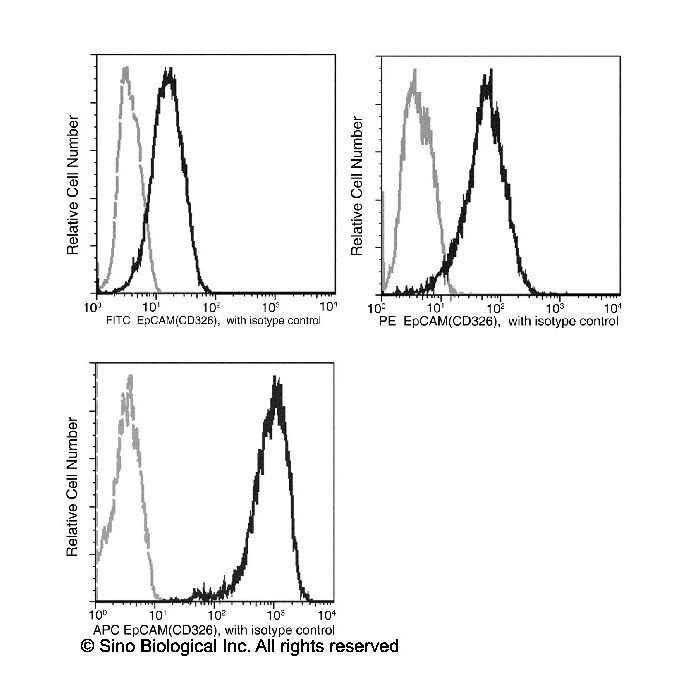

-MM06-FITC-PE-APC-SKBR3.png)