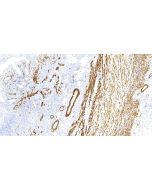
Recombinant Human EphrinA3 protein (Catalog#10188-H08H)
Preparation
Produced in rabbits immunized with purified, recombinant Human Ephrin-A3 (rh EphrinA3; Catalog#10188-H08H; NP_004943.1; Met 1-Ser 213). Total IgG was purified by Protein A affinity chromatography.
Source
Polyclonal Rabbit IgG
Purification
Protein A
Formulation
0.2 μm filtered solution in PBS
Conjugate
Unconjugated
Form
Liquid
Shipping
This antibody is shipped as liquid solution at ambient temperature. Upon receipt, store it immediately at the temperature recommended below.
Storage
This antibody can be stored at 2℃-8℃ for one month without detectable loss of activity. Antibody products are stable for twelve months from date of receipt when stored at -20℃ to -80℃. Preservative-Free. Avoid repeated freeze-thaw cycles.
Ephrin-A3 also known as EPH-related receptor tyrosine kinase ligand 3 or EFNA3, is a member of the ephrin family. The Eph family receptor interacting proteins (ephrins) are a family of proteins that serve as the ligands of the Eph receptor, which compose the largest known subfamily of receptor protein-tyrosine kinases (RTKs). Ephrin-A3 and their Eph family of receptor tyrosine kinases are expressed by cells of the SVZ. Ephrin subclasses are further distinguished by their mode of attachment to the plasma membrane: Ephrin-A3 ligands bind EphA receptors and are anchored to the plasma membrane via a glycosylphosphatidylinositol (GPI) linkage, whereas ephrin-B ligands bind EphB receptors and are anchored via a transmembrane domain. Ephrin-A3 expressed on astrocytes activates EphA4 on the post-synaptic neuron and restricts the growth of dendritic spines through multiple pathways.
References
Klein R. (2009) Bidirectional modulation of synaptic functions by Eph/ephrin signaling. Nat Neurosci. 12(1): 15-20.
Lai KO, et al. (2009) Synapse development and plasticity: roles of ephrin/Eph receptor signaling. Curr Opin Neurobiol. 19(3): 275-83.
Prevost N, et al. (2002) Interactions between Eph kinases and ephrins provide a mechanism to support platelet aggregation once cell-to-cell contact has occurred. Proc Natl Acad Sci U S A. 99(14): 9219-24.