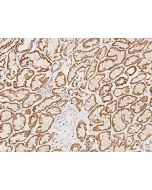
Recombinant Anti-Factor XI Antibody, Rabbit Monoclonal
Validated applications
ELISA (FAQ Protocol)
Species reactivity
Reacts with: Human
Specificity
Human Factor XI No cross-reactivity in ELISA with Human FX Human uPA Human KLK1 Human KLK11 Human HGFA Human KLK3 Human KLK4 Human KLK8
Immunogen
Recombinant Human Coagulation Factor XI / F11 protein (Catalog#10302-H08H)
Preparation
This antibody was obtained from a rabbit immunized with purified, recombinant Human Coagulation Factor XI / F11 (rh Coagulation Factor XI / F11; Catalog#10302-H08H; NP_000119.1; Met1-Val625).
Source
Monoclonal Rabbit IgG Clone #007
Purification
Protein A
Formulation
0.2 μm filtered solution in PBS
Conjugate
Unconjugated
Form
Liquid
Shipping
This antibody is shipped as liquid solution at ambient temperature. Upon receipt, store it immediately at the temperature recommended below.
Storage
This antibody can be stored at 2℃-8℃ for one month without detectable loss of activity. Antibody products are stable for twelve months from date of receipt when stored at -20℃ to -80℃. Preservative-Free. Avoid repeated freeze-thaw cycles.
Synonyms: Anti-FXI Antibody; Anti-PTA Antibody
Background Information
Full Name
coagulation factor XI
Description
Factor XI (plasma thromboplastin antecedent) is a plasma glycoprotein, and a zymogen acting as a serine protease which participates in blood coagulation as a catalyst in the conversion of factor IX to factor IXa in the presence of calcium ions. It is an unusual dimeric protease, with structural features that distinguish it from vitamin K-dependent coagulation proteases. The factor XI is synthesized in the liver as a single polypeptide chain with a molecular weight estimated between 125 ~160 kDa and then is processed into a disulfide-bond linked homodimer. FXI is a homodimer, with each subunit containing four apple domains and a protease domain. The apple domains form a disk structure with binding sites for platelets, high molecular weight kininogen, and the substrate factor IX (FIX). FXI is converted to the active protease FXIa by cleavage of the Arg369-Ile370 bond on each subunit. After the activation reaction, Factor XIa is composed of two heavy and two light chains held together by three disulfide bonds. The heavy chains are derived from the amino termini of the zymogen and responsible for the binding of factor XI to high molecular weight kininogen and for the activation of factor IX, while the light chain contains the catalytic portion of the enzyme and is homologous to the trypsin family of serine proteases. FXI deficiency is a disorder characterized by a mild or no bleeding tendency. Severe FXI deficiency is an injury-related bleeding disorder common in Ashkenazi Jews and rare worldwide.
Research Areas
Serine Proteases and Regulators
References
Gailani D, et al. (2009) Structural and functional features of factor XI. J Thromb Haemost. 7 Suppl 1: 75-8.
Duga S, et al. (2009) Factor XI Deficiency. Semin Thromb Hemost. 35(4): 416-25.
Emsley J, et al. (2010) Structure and function of factor XI. Blood. 115(13): 2569-77.