WB (FAQ Protocol), ELISA (FAQ Protocol), IP (FAQ Protocol)
Species reactivity
Reacts with: Human
Specificity
Human FKBP7
Immunogen
Recombinant Human FKBP7 / Rotamase protein (Catalog#13250-H08H)
Preparation
Produced in rabbits immunized with purified, recombinant Human FKBP7 / Rotamase (rh FKBP7 / Rotamase; Catalog#13250-H08H; Q9Y680-2; Met1-Gln218). FKBP7 / Rotamase specific IgG was purified by Human FKBP7 / Rotamase affinity chromatography.
Source
Polyclonal Rabbit IgG
Purification
Protein A & Antigen Affinity
Formulation
0.2 μm filtered solution in PBS
Conjugate
Unconjugated
Form
Liquid
Shipping
This antibody is shipped as liquid solution at ambient temperature. Upon receipt, store it immediately at the temperature recommended below.
Storage
This antibody can be stored at 2℃-8℃ for one month without detectable loss of activity. Antibody products are stable for twelve months from date of receipt when stored at -20℃ to -80℃. Preservative-Free. Avoid repeated freeze-thaw cycles.
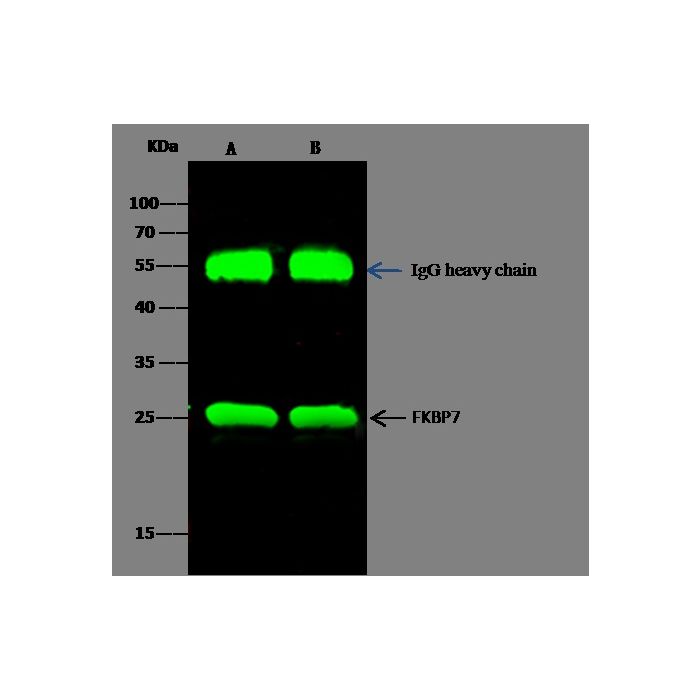
FKBP7 was immunoprecipitated using: Lane A:0.5 mg HepG2 Whole Cell Lysate Lane B:0.5 mg 293T Whole Cell Lysate 2 µL anti-FKBP7 rabbit polyclonal antibody and 15 μl of 50 % Protein G agarose. Primary antibody: Anti-FKBP7 rabbit polyclonal antibody,at 1:200 dilution Secondary antibody: Dylight 800-labeled antibody to rabbit IgG (H+L), at 1:5000 dilution Developed using the odssey technique. Performed under reducing conditions. Predicted band size: 26 kDa Observed band size: 26 kDa
Image 1 Alt Text
Human FKBP7 / Rotamase Immunoprecipitation(IP) 6052
FKBP7 was immunoprecipitated using: Lane A:0.5 mg HepG2 Whole Cell Lysate Lane B:0.5 mg 293T Whole Cell Lysate 2 µL anti-FKBP7 rabbit polyclonal antibody and 15 μl of 50 % Protein G agarose. Primary antibody: Anti-FKBP7 rabbit polyclonal antibody,at 1:200 dilution Secondary antibody: Dylight 800-labeled antibody to rabbit IgG (H+L), at 1:5000 dilution Developed using the odssey technique. Performed under reducing conditions. Predicted band size: 26 kDa Observed band size: 26 kDa
PPIase is a member of the immunophilin protein family. It also belongs to the cyclophilin-type PPIase family, PPIL3 subfamily. PPIase contains 1 PPIase cyclophilin-type domain. Members of the immunophilin protein family play a role in immunoregulation and basic cellular processes involving protein folding and trafficking. PPIases accelerate the folding of proteins. It catalyzes the cis-trans isomerization of proline imidic peptide bonds in oligopeptides. It has a very high substrate specificity for the four-residue peptide Ala-Ala-Pro-Phe only when the proline peptide bond is in the trans state. It interacts with several intracellular signal transduction proteins including type I TGF-beta receptor. It also interacts with multiple intracellular calcium release channels, and coordinates multi-protein complex formation of the tetrameric skeletal muscle ryanodine receptor. In mouse, deletion of this homologous gene causes congenital heart disorder known as noncompaction of left ventricular myocardium.
References
1. Shor B, et al. (2008) A new pharmacologic action of CCI-779 involves FKBP12-independent inhibition of mTOR kinase activity and profound repression of global protein synthesis. Cancer Res. 68(8):2934-43.
2. Talmud PJ, et al. (2009) Gene-centric association signals for lipids and apolipoproteins identified via the HumanCVD BeadChip. Am J Hum Genet. 85(5):628-42.
3. Deleersnijder A, et al. (2011) Comparative analysis of different peptidyl-prolyl isomerases reveals FK506-binding protein 12 as the most potent enhancer of alpha-synuclein aggregation. J Biol Chem. 286(30):26687-701.


-HB07MA3107-IP.png)
-HB07MA3107-WB.png)