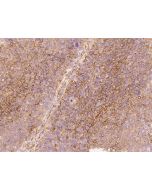
Anti-HMGB1 Antibody, Mouse Monoclonal sinobiological 10326-MM22
$243.00
In stock
SKU
10326-MM22
| Catalog No. | Size | Price (USD) |
| 10326-MM22-100 | 100 µL | $251.64 |
| Catalog No. | Size | Price (USD) |
| 10326-MM22-100 | 100 µL | $251.64 |
General Information
| Product name | Anti-HMGB1 Antibody, Mouse Monoclonal |
| Validated applications | ELISA (FAQ Protocol) |
| Species reactivity | Reacts with: Human |
| Specificity | Human HMGB1 |
| Immunogen | Recombinant Human HMGB1 Protein (Catalog#10326-H07E) |
| Preparation | This antibody was produced from a hybridoma resulting from the fusion of a mouse myeloma with B cells obtained from a mouse immunized with purified, recombinant Human HMGB1 (rh HMGB1; Catalog#10326-H07E; P09429; Lys57-Asp158). The IgG fraction of the cell culture supernatant was purified by Protein A affinity chromatography. |
| Source | Monoclonal Mouse IgG2b Clone #22 |
| Purification | Protein A |
| Formulation | 0.2 μm filtered solution in PBS |
| Conjugate | Unconjugated |
| Form | Liquid |
| Shipping | This antibody is shipped as liquid solution at ambient temperature. Upon receipt, store it immediately at the temperature recommended below. |
| Storage | This antibody can be stored at 2℃-8℃ for one month without detectable loss of activity. Antibody products are stable for twelve months from date of receipt when stored at -20℃ to -80℃. Preservative-Free. Avoid repeated freeze-thaw cycles. |
Synonyms: Anti-DKFZp686A04236 Antibody; Anti-HMG-1 Antibody; Anti-HMG1 Antibody; Anti-HMG3 Antibody; Anti-SBP-1 Antibody
Background Information
| Full Name | high mobility group box 1 |
| Description | High-mobility group box 1 protein (HMGB1), also known as HMG-1 or amphoterin previously, is a member of the HMGB family consisting of three members, HMGB1, HMGB2, and HMGB3. HMGB1 is a DNA-binding nuclear protein, released actively following cytokine stimulation as well as passively during cell death. It is the prototypic damage-associated molecular pattern (DAMP) molecule and has been implicated in several inflammatory disorders. HMGB1 signals via the receptor for advanced glycation end-product (RAGE) and members of the toll-like receptor (TLR) family. The most prominent HMGB1 protein and mRNA expression arthritis are present in pannus regions, where synovial tissue invades articular cartilage and bone. HMGB1 promotes the activity of proteolytic enzymes, and osteoclasts need HMGB1 for functional maturation. As a non-histone nuclear protein, HMGB1 has a dual function. Inside the cell, HMGB1 binds DNA, regulating transcription, and determining chromosomal architecture. Outside the cell, HMGB1 can serve as an alarmin to activate the innate system and mediate a wide range of physiological and pathological responses. Extracellular HMGB1 represents an optimal " necrotic marker" selected by the innate immune system to recognize tissue damage and initiate reparative responses. However, extracellular HMGB1 also acts as a potent pro-inflammatory cytokine that contributes to the pathogenesis of diverse inflammatory and infectious disorders. HMGB1 has been successfully therapeutically targeted in multiple preclinical models of infectious and sterile diseases including arthritis. As shown in studies on patients as well as animal models, HMGB1 can play an important role in the pathogenesis of the rheumatic disease, including rheumatoid arthritis, systemic lupus erythematosus, and polymyositis among others. Besides, enhanced postmyocardial infarction remodeling in type 1 diabetes mellitus was partially mediated by HMGB1 activation. |
| Related Pathways |
|
| References |
|