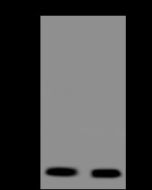
Recombinant Human ICOS Ligand / B7-H2 protein (Catalog#11559-H08H)
Preparation
This antibody was produced from a hybridoma resulting from the fusion of a mouse myeloma with B cells obtained from a mouse immunized with purified, recombinant Human ICOS Ligand / B7-H2 (rh ICOS Ligand / B7-H2; Catalog#11559-H08H; NP_056074.1; Met1-Ser258) and conjugated with PE under optimum conditions, the unreacted PE was removed.
Source
Monoclonal Mouse IgG1 Clone #01
Purification
Protein A
Formulation
PBS solution containing 0.5% BSA and 0.03%ProClin300
Concentration
5 μl/Test, 0.1 mg/ml
Conjugate
PE
Form
Liquid
Shipping
This antibody is shipped as liquid solution at ambient temperature. Upon receipt, store it immediately at the temperature recommended below.
Storage
This antibody can be stored at 2℃-8℃ for twelve months without detectable loss of activity. Protected from prolonged exposure to light. Do not freeze !
Inducible co-stimulator ligand (ICOSL), also known as B7-H2, is a member of the B7 family of co-stimulatory molecules related to B7-1 and B7-2. It is a transmembrane glycoprotein with extracellular IgV and IgC domains and binds to ICOS on activated T cells, thus delivers a positive costimulatory signal for optimal T cell function. The structural features of ICOSL are crucial for its costimulatory function. The present study shows that ICOSL displays a marked oligomerization potential, resembling more like B7-1 than B7-2. B7-H2-dependent signaling may play an active role in a proliferative response rather than in cytokine and chemokine production. The CD28/B7 and ICOS/B7-H2 pathways are both critical for costimulating T cell immune responses. Deficiency in either pathway results in defective T cell activation, cytokine production, and germinal center formation.
Kajiwara K, et al. (2009) Expression and function of the inducible costimulator ligand B7-H2 in human airway smooth muscle cells. Allergol Int. 58(4): 573-83.
Wong SC, et al. (2009) Functional hierarchy and relative contribution of the CD28/B7 and ICOS/B7-H2 costimulatory pathways to T cell-mediated delayed-type hypersensitivity. Cell Immunol. 256(1-2): 64-71.