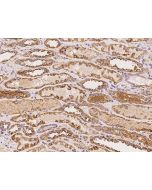
Recombinant Human LAMP-1 / CD107a protein (Catalog#11215-H08H)
Preparation
This antibody was obtained from a rabbit immunized with purified, recombinant Human LAMP-1 / CD107a (rh LAMP-1 / CD107a; Catalog#11215-H08H; NP_005552.3; Met1-Met382) and conjugated with FITC under optimum conditions, the unreacted FITC was removed.
Source
Monoclonal Rabbit IgG Clone #107
Purification
Protein A
Formulation
PBS solution containing 0.5% BSA and 0.09% sodium azide
Concentration
5 μl/Test, 0.1 mg/ml
Conjugate
FITC
Form
Liquid
Shipping
This antibody is shipped as liquid solution at ambient temperature. Upon receipt, store it immediately at the temperature recommended below.
Storage
This antibody can be stored at 2℃-8℃ for twelve months without detectable loss of activity. Protected from prolonged exposure to light. Do not freeze ! Sodium azide is toxic to cells and should be disposed of properly. Flush with large volumes of water during disposal.
Flow cytometric analysis of Human LAMP1 (CD107a) expression in Jurkat cells. The cells were treated according to manufacturer’s manual (BD Pharmingen™ Cat. No. 554714), and then stained with FITC Mouse anti-LAMP1. The fluorescence histograms were derived from gated events with the forward and side light-scatter characteristics of intact cells.
Lysosome-associated membrane glycoprotein 1, also known as CD107 antigen-like family member A, CD107a, and LAMP1, is a single-pass type I membrane protein that belongs to the LAMP family. CD107a is expressed largely in the endosome-lysosome membranes of cells but is also found on the plasma membrane (1-2% of total LAMP1). LAMP1 has been implicated in a variety of cellular functions, including cancer metastasis. It has been proposed LAMP1 serves as a therapeutic agent for some cancers, as well as a marker for lysosomal storage disorders and different cell types such as cytotoxic T cells. LAMP2, also known as CD107b, may also play a role in tumor cell metastasis and functions in the protection, maintenance, and adhesion of the lysosome. Cell surface LAMP1 and LAMP2 have been shown to promote adhesion of human peripheral blood mononuclear cells (PBMC) to vascular endothelium, therefore they are possibly involved in the adhesion of PBMCs to the site of inflammation. LAMP-1 is a glycoprotein highly expressed in lysosomal membranes. The present study was initiated to test LAMP-1 mRNA and protein levels in post mortem frontal cortex (area 8) of Alzheimer's disease (AD) stages I-IIA/B and stages V-VIC of Braak and Braak, compared with age-matched controls. LAMP-1 occurred in microglia and multinucleated giant cells in one AD case in which amyloid burden was cleared following beta A-peptide immunization. Also, LAMP-1 has been suggested to be a cell surface receptor for a specific amelogenin isoform, leucine-rich amelogenin peptide, or LRAP. LAMP-1 can serve as a cell surface binding site for amelogenin on dental follicle cells and cementoblasts.
References
Parkinson-Lawrence EJ, et al. (2005) Immunochemical analysis of CD107a (LAMP-1). Cell Immunol. 236(1-2): 161-6.
Barrachina M, et al. (2006) Lysosome-associated membrane protein 1 (LAMP-1) in Alzheimer's disease. Neuropathol Appl Neurobiol. 32(5): 505-16.
Zhang H, et al. (2010) Full length amelogenin binds to cell surface LAMP-1 on tooth root/periodontium associated cells. Arch Oral Biol. 55(6): 417-25.