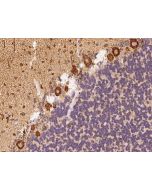
Recombinant Human CCL15 / MIP-5 / MIP-1 delta protein (Catalog#10898-H08E)
Preparation
Produced in rabbits immunized with purified, recombinant Human CCL15 / MIP-5 / MIP-1 delta (rh CCL15 / MIP-5 / MIP-1 delta; Catalog#10898-H08E; Q16663-1; Gln22-Ile113). CCL15 / MIP-5 / MIP-1 delta specific IgG was purified by Human CCL15 / MIP-5 / MIP-1 delta affinity chromatography.
Source
Polyclonal Rabbit IgG
Purification
Protein A & Antigen Affinity
Formulation
0.2 μm filtered solution in PBS
Conjugate
Unconjugated
Form
Liquid
Shipping
This antibody is shipped as liquid solution at ambient temperature. Upon receipt, store it immediately at the temperature recommended below.
Storage
This antibody can be stored at 2℃-8℃ for one month without detectable loss of activity. Antibody products are stable for twelve months from date of receipt when stored at -20℃ to -80℃. Preservative-Free. Avoid repeated freeze-thaw cycles.
Chemokines are a family of small chemotactic cytokines, or proteins secreted by cells. Chemokines share the same structure similarities such as small size, and the presence of four cysteine residues in conserved locations in order to form their 3-dimensional shape. Some of the chemokines are considered pro-inflammatory which can be induced to recruit cells of the immune system to a site of infection during an immune response, while others are considered homeostatic and are implied in controlling the migration of cells during normal processes of tissue maintenance and development. There are four members of the chemokine family: C-C kemokines, C kemokines, CXC kemokines and CX3C kemokines. The C-C kemokines have two cysteines nearby the amino terminus. There have been at least 27 distinct members of this subgroup reported for mammals, called C-C chemokine ligands-1 to 28. Chemokine ligand 15 (CCL15), also known as leukotactin-1, MIP5, MIP1 and HCC-2, is a small cytokine belonging to the C-C chemokine family. CCL15 is prevantly expressed in liver, small intestine, colon, and in certain leukocytes and macrophages of the lung. It is chemotactic for neutrophils, monocytes, and lymphocytes and elicits its effects by binding to cell surface chemokine receptors like CCR1 and CCR3.
References
Laing KJ, et al. (2004) Chemokines. Developmental and comparative immunology. 28(5): 443-60.
Youn, et al. (1997) Molecular cloning of leukotactin-1: a novel human beta-chemokine, a chemoattractant for neutrophils, monocytes, and lymphocytes, and a potent agonist at CC chemokine receptors 1 and 3. J Immun. 159: 5201-5.
Coulin, et al. (1997) Characterization of macrophage inflammatory protein-5 / human CC cytokine-2, a member of the macrophage-inflammatory-protein family of chemokines. Europ J Biochem. 248: 507-15.