Reacts with: Human Predicted to React with: > Human Phospho-PKCα (Thr638) Predicted to React with: Species predicted to react based on 100% sequence homology: Mouse, Rat, Cynomolgus, Bovine
Specificity
Reacts with: Human Human Phospho-PKCα (Thr638) Predicted to React with: Species predicted to react based on 100% sequence homology: Mouse, Rat, Cynomolgus, Bovine
Immunogen
A synthetic phosphopeptide corresponding to residues around Thr638 of human Phospho-PKCα.
Preparation
This antibody was obtained from a rabbit immunized with a synthetic phosphopeptide corresponding to residues around Thr638 of human Phospho-PKCα.
Source
Monoclonal Rabbit IgG Clone #0049
Purification
Protein A
Formulation
10 mM sodium HEPES, 150 mM NaCl, 100 μg/mL BSA, 50% glycerol, pH 7.5
Conjugate
Unconjugated
Form
Liquid
Shipping
This antibody is shipped as liquid solution at ambient temperature. Upon receipt, store it immediately at the temperature recommended below.
Storage
This antibody can be stored at 2℃-8℃ for one month without detectable loss of activity. Antibody products are stable for twelve months from date of receipt when stored at -20℃ to -80℃. Preservative-Free. Avoid repeated freeze-thaw cycles.
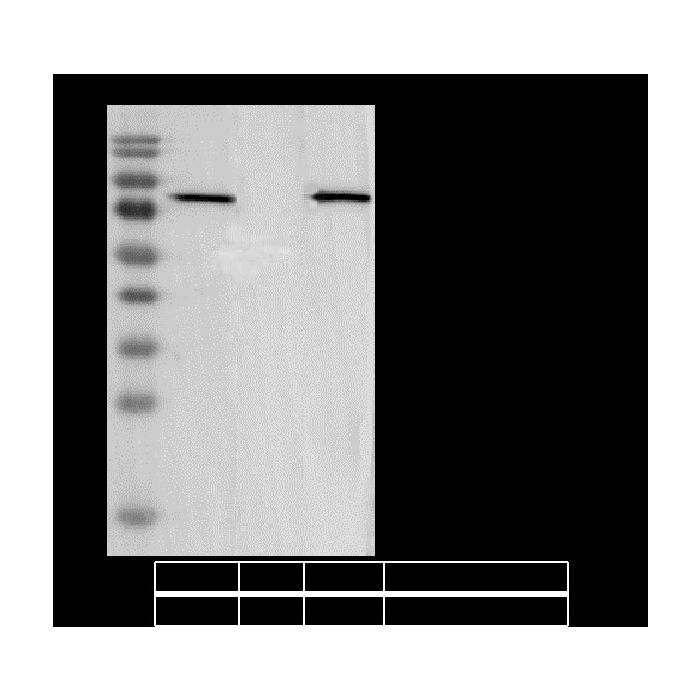
Western blot analysis of extracts from HEK-293, untreated (line A); treated with antigen-specific phosphopeptide (line B) or antigen-specific peptide (line C) using Phospho-PKCα (Thr638) Antibody, Rabbit MAb (Cat: 111172-R0049) at 1:1000 dilution.
Western blot analysis of extracts from HEK-293, untreated (line A); treated with antigen-specific phosphopeptide (line B) or antigen-specific peptide (line C) using Phospho-PKCα (Thr638) Antibody, Rabbit MAb (Cat: 111172-R0049) at 1:1000 dilution.
Protein kinase C alpha (PRKCA) is involved in multiple functions and has been implicated in heart failure risks and treatment outcomes. The protein kinase C alpha (PRKCA) gene, coding for a Th17-cell-selective kinase, shows a complex splicing pattern, with at least 2 stable alternative transcripts characterized by an alternative upstream polyadenylation site. Polymorphisms in this gene were associated with several conditions, including multiple sclerosis, asthma, schizophrenia, and cancer. The protein kinase C alpha (PRKCA) gene, encoding a Th17-cell-selective kinase, was repeatedly associated with multiple sclerosis (MS).PRKCA polymorphisms and gene-gene interactions within the ACEi pathway affect the antihypertensive responses to enalapril.