Reacts with: Human Predicted to React with: Species predicted to react based on 100% sequence homology: Mouse, Rat, Cynomolgus, Rabbit
Specificity
Human Species predicted to react based on 100% sequence homology: Mouse, Rat, Cynomolgus, Rabbit
Immunogen
A synthetic peptide corresponding to residues around (Tyr1234, 1235) of Human Phospho-Met
Preparation
This antibody was obtained from a rabbit immunized with a synthetic peptide corresponding to residues around (Tyr1234, 1235) of Human Phospho-Met.
Source
Monoclonal Rabbit IgG Clone #0060
Purification
Protein A
Formulation
10 mM sodium HEPES, 150 mM NaCl, 100 μg/mL BSA, 50% glycerol, pH 7.5
Conjugate
Unconjugated
Form
Liquid
Shipping
This antibody is shipped as liquid solution at ambient temperature. Upon receipt, store it immediately at the temperature recommended below.
Storage
This antibody can be stored at 2℃-8℃ for one month without detectable loss of activity. Antibody products are stable for twelve months from date of receipt when stored at -20℃ to -80℃. Preservative-Free. Avoid repeated freeze-thaw cycles.
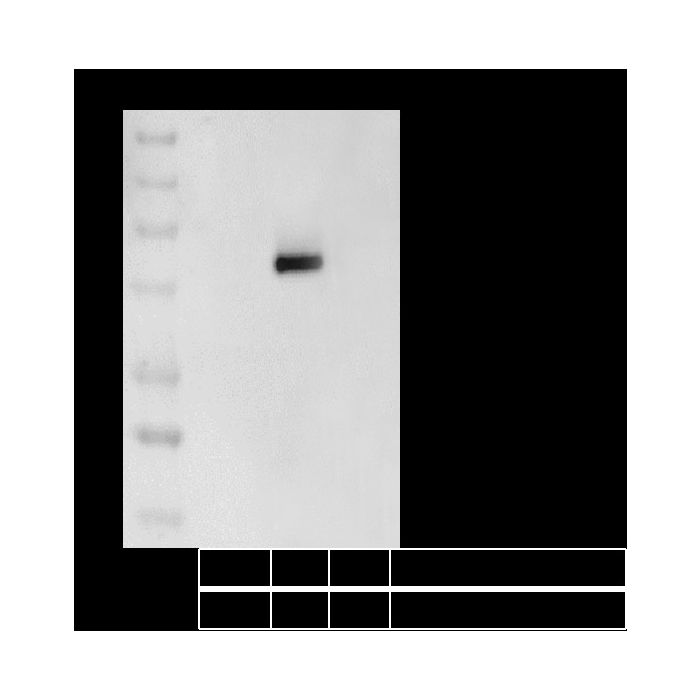
Western blot analysis of extracts from serum-starved A549, untreated (line A); treated with HGF(Cat# 10463-HNAS) (50 ng/mL, 5min; +) (line B); treated with HGF and λ-phosphatase (Cat# L01-20U) (line C) using Phospho-Met(Tyr1234, 1235) rabbit monoclonal Antibody (Cat# 110587-R0060) at 1:1000 dilution. (Validation Experiment)
Western blot analysis of extracts from serum-starved A549, untreated (line A); treated with HGF(Cat# 10463-HNAS) (50 ng/mL, 5min; +) (line B); treated with HGF and λ-phosphatase (Cat# L01-20U) (line C) using Phospho-Met(Tyr1234, 1235) rabbit monoclonal Antibody (Cat# 110587-R0060) at 1:1000 dilution. (Validation Experiment)
Hepatocyte growth factor receptor (HGFR), also known as c-Met or mesenchymal-epithelial transition factor (MET), is a receptor tyrosine kinase (RTK) that is overexpressed and/or mutated in a variety of malignancies. HGFR protein is produced as a single-chain precursor, and HGF is the only known ligand. Normal HGF/HGFR signaling is essential for embryonic development, tissue repair, or wound healing, whereas aberrantly active HGFR has been strongly implicated in tumorigenesis, particularly in the development of invasive and metastatic phenotypes. HGFR protein is a multifaceted regulator of growth, motility, and invasion, and is normally expressed by cells of epithelial origin. Preclinical studies suggest that targeting aberrant HGFR signaling could be an attractive therapy in cancer.
Research Areas
Cancer Drug Targets
Receptor Tyrosine Kinases (RTKs)
Tags
Cancer Immunotherapy
Immune Checkpoint
Immunotherapy
Targeted Therapy
References
McGill GG, et al. (2006) c-Met expression is regulated by Mitf in the melanocyte lineage. J Biol Chem. 281(15): 10365-73.
Garcia S, et al. (2007) c-Met overexpression in inflammatory breast carcinomas: automated quantification on tissue microarrays. British journal of cancer. 96(2): 329-35.
Socoteanu MP, et al. (2008) c-Met targeted therapy of cholangiocarcinoma. World J Gastroenterol. 14(19): 2990-4.
Kong DS, et al. (2009) Prognostic significance of c-Met expression in glioblastomas. Cancer. 115(1): 140-8.