Human Mouse (Species predicted to react based on 100% sequence homology)
Immunogen
A synthetic peptide corresponding to the C-terminus of the Human NAA50
Preparation
Produced in rabbits immunized with a synthetic peptide corresponding to the C-terminus of the Human NAA50, and purified by antigen affinity chromatography.
Source
Polyclonal Rabbit IgG
Purification
Protein A & Antigen Affinity
Formulation
PBS, pH7.0 with 0.03% Proclin300
Conjugate
Unconjugated
Form
Liquid
Shipping
This antibody is shipped as liquid solution at ambient temperature. Upon receipt, store it immediately at the temperature recommended below.
Storage
This antibody can be stored at 2℃-8℃ for one month without detectable loss of activity. Antibody products are stable for twelve months from date of receipt when stored at -20℃ to -80℃. Avoid repeated freeze-thaw cycles.
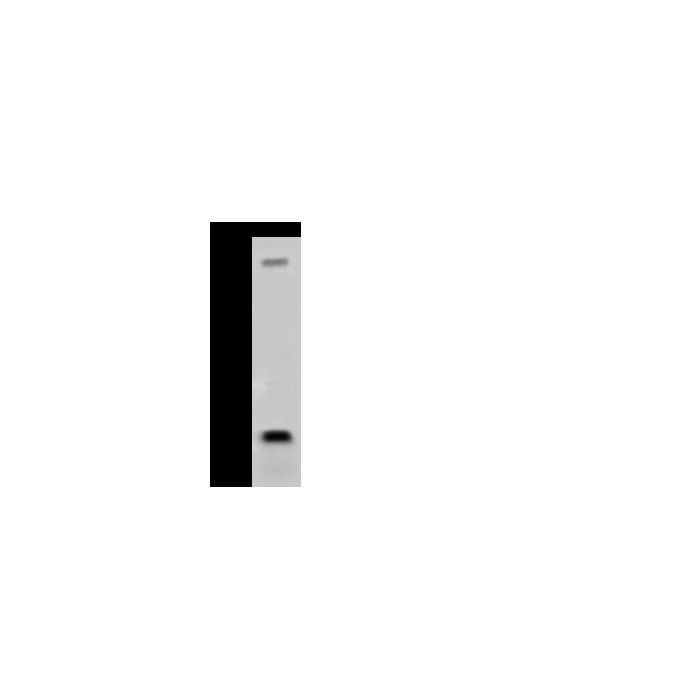
Anti-NAA50 rabbit polyclonal antibody at 1:500 dilution Lane A: K562 Whole Cell Lysate Lysates/proteins at 30 μg per lane. Secondary Goat Anti-Rabbit IgG (H+L)/HRP at 1/10000 dilution. Developed using the ECL technique. Performed under reducing conditions. Predicted band size:19 kDa Observed band size:19 kDa
Naa50 (also known as San) has previously been shown to play a role in sister-chromatid cohesion in metazoans. The gene separation anxiety (san) encodes Naa50/San, an N-terminal acetyltransferase required for chromosome segregation during mitosis. Naa50/San N-terminally acetylates the nascent Scc1 polypeptide, and that this co-translational modification is subsequently required for the establishment and/or maintenance of sister chromatid cohesion. NAA50, an interactor of EDR1, plays an important role in regulating the tradeoff between plant growth and defense. Plants lacking NAA50 display severe developmental defects as well as induced stress responses. Reduction of NAA50 expression results in arrested stem and root growth as well as senescence. The loss of NAA50 results in constitutive ER stress signaling, indicating that NAA50 may be required for the suppression of ER stress.
References
Rong Z, et al. (2016) Opposing functions of the n-terminal acetyltransferases naa50 and nata in sister-chromatid cohesion. J Biol Chem 291 (36): 19079-19091.
Ribeiro AL, et al. (2016) Naa50/san-dependent n-terminal acetylation of scc1 is potentially important for sister chromatid cohesion. Sci Rep 6 39118.
Neubauer M, et al. (2020) Loss of the acetyltransferase naa50 induces endoplasmic reticulum stress and immune responses and suppresses growth. Plant Physiol 183 (4): 1838-1854.


-HD12FE0115-WB.png)