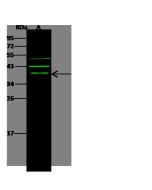
Recombinant Human NBL1 / DAND1 Protein (Catalog#10169-H08H)
Preparation
This antibody was produced from a hybridoma resulting from the fusion of a mouse myeloma with B cells obtained from a mouse immunized with purified, recombinant Human NBL1 / DAND1 (rh NBL1 / DAND1; Catalog#10169-H08H; NP_005371.1; Met1-Asp180). The IgG fraction of the cell culture supernatant was purified by Protein A affinity chromatography.
Source
Monoclonal Mouse IgG1 Clone #06
Purification
Protein A
Formulation
0.2 μm filtered solution in PBS
Conjugate
Unconjugated
Form
Liquid
Shipping
This antibody is shipped as liquid solution at ambient temperature. Upon receipt, store it immediately at the temperature recommended below.
Storage
This antibody can be stored at 2℃-8℃ for one month without detectable loss of activity. Antibody products are stable for twelve months from date of receipt when stored at -20℃ to -80℃. Preservative-Free. Avoid repeated freeze-thaw cycles.
The Dan (Differential screening-selected gene aberrative in neuroblastoma, also known as N03) gene was first identified as the putative rat tumor suppressor gene and encodes a protein structurally related to Cerberus and Gremlin in the vertebrates. It is a founding member of the DAN family of secreted proteins, acts as an inhibitor of cell cycle progression, and is closely involved in retinoic acid-induced neuroblastoma differentiation. There are at least five mammalian protein members in the evolutionarily conserved Dan family including DAN, Gremlin/DRM, Cer1 (Cerberus-related), Dante, and PRDC (protein related to DAN and Cerberus), and share the C-terminal cystine-knot motif. As a secreted glycoprotein, DAN is a member of a class of glycoproteins shown to be secreted inhibitors of the transforming growth factor-beta (TGF-beta) and bone morphogenic protein pathways. It binds to BMPs and preventing their interactions with signaling receptor complexes, and accordingly regulates the processes of embryonic development and tissue differentiation. DAN gene product may have an important role in the regulation of the entry of cells into the S phase. Besides, the DAN gene product possesses an ability to revert phenotypes of transformed rat fibroblasts and represents a candidate tumor suppressor gene for neuroblastoma.
References
Ozaki T, et al. (1995) Overexpression of DAN gene product in normal rat fibroblasts causes a retardation of the entry into the S phase. Cancer Res. 55(4): 895-900.
Nakamura Y, et al. (1997) A product of DAN, a novel candidate tumour suppressor gene, is secreted into culture medium and suppresses DNA synthesis. Eur J Cancer. 33(12): 1986-90.
Ogita J, et al. (2001) Expression of the Dan gene during chicken embryonic development. Mech Dev. 109(2): 363-5.
Kim AS, et al. (2003) Expression of the BMP antagonist Dan during murine forebrain development. Brain Res Dev Brain Res. 145(1): 159-62.