WB (FAQ Protocol), ELISA (FAQ Protocol), IP (FAQ Protocol)
Species reactivity
Reacts with: Human
Specificity
Human SMAC
Immunogen
Recombinant Human Diablo protein (Catalog#10339-H08E)
Preparation
Produced in rabbits immunized with purified, recombinant Human Diablo (rh Diablo; Catalog#10339-H08E; NP_063940.1; Ala 56-Asp 239). Diablo specific IgG was purified by human Diablo affinity chromatography .
Source
Polyclonal Rabbit IgG
Purification
Protein A & Antigen Affinity
Formulation
0.2 μm filtered solution in PBS
Conjugate
Unconjugated
Form
Liquid
Shipping
This antibody is shipped as liquid solution at ambient temperature. Upon receipt, store it immediately at the temperature recommended below.
Storage
This antibody can be stored at 2℃-8℃ for one month without detectable loss of activity. Antibody products are stable for twelve months from date of receipt when stored at -20℃ to -80℃. Preservative-Free. Avoid repeated freeze-thaw cycles.
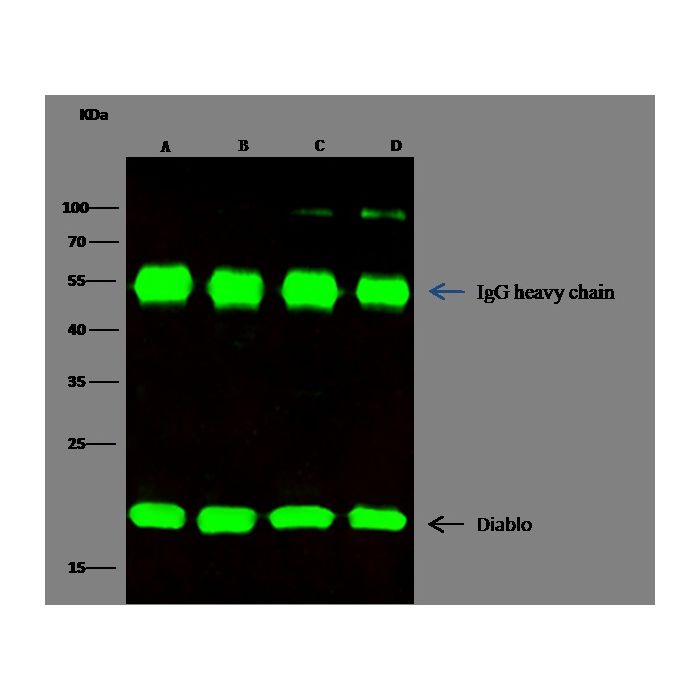
Diablo was immunoprecipitated using: Lane A:0.5 mg Hela Whole Cell Lysate Lane B:0.5 mg A431 Whole Cell Lysate Lane C:0.5 mg MCF-7 Whole Cell Lysate Lane D:0.5 mg SH-SY5Y Whole Cell Lysate 2 µL anti-Diablo rabbit polyclonal antibody and 15 μl of 50 % Protein G agarose. Primary antibody: Anti-Diablo rabbit polyclonal antibody,at 1:500 dilution Secondary antibody: Dylight 800-labeled antibody to rabbit IgG (H+L), at 1:5000 dilution Developed using the odssey technique. Performed under reducing conditions. Predicted band size: 19 kDa Observed band size: 19 kDa
Diablo was immunoprecipitated using: Lane A:0.5 mg Hela Whole Cell Lysate Lane B:0.5 mg A431 Whole Cell Lysate Lane C:0.5 mg MCF-7 Whole Cell Lysate Lane D:0.5 mg SH-SY5Y Whole Cell Lysate 2 µL anti-Diablo rabbit polyclonal antibody and 15 μl of 50 % Protein G agarose. Primary antibody: Anti-Diablo rabbit polyclonal antibody,at 1:500 dilution Secondary antibody: Dylight 800-labeled antibody to rabbit IgG (H+L), at 1:5000 dilution Developed using the odssey technique. Performed under reducing conditions. Predicted band size: 19 kDa Observed band size: 19 kDa
Apoptosis is an essential processes required for normal development and homeostasis of all metazoan organisms. Second Mitochondria-Derived Activator of Caspases (Smac) or Direct IAP Binding Protein with low isoelectric point, pI (Diablo) is a proapoptogenic mitochondrial protein that is released to the cytosol in response to diverse apoptotic stimuli, including commonly used chemotherapeutic drugs. The current knowlege about structure and function of Smac/Diablo during programmed cell death, both in mitochondrial and receptor pathways are presented. It has been shown that Diablo mainly interacts with IAPs in the cytochrome c/Apaf-1/caspase-9 pathway, and promotes apoptosis. Diablo is released from the mitochondria into the cytosol occurring downstream of cytochrome c release in response to apoptotic stimuli such as irradiation, DNA damage or cytotoxic drugs. In the cytosol, Smac/Diablo interacts and antagonizes inhibitors of apoptosis proteins (IAPs), thus allowing the activation of caspases and apoptosis. This activity has prompted the synthesis of peptidomimetics that could potentially be used in cancer therapy. The role of Smac/DIABLO in colorectal carcinogenesis is ill defined. Data continues to accumulate to suggest that decreased levels of Smac/DIABLO may be important in chemoradiation-resistance to apoptosis in advanced colon cancer.
Related Pathways
Death Receptor Signaling
TNF Signaling
References
Korga A, et al. (2006) Role of mitochondrial protein Smac/Diablo in regulation of apoptotic pathways Pol Merkur Lekarski. 20(119): 573-6.
Anguiano-Hernandez YM, et al. (2007) Smac/DIABLO and colon cancer. Anticancer Agents Med Chem. 7(4): 467-73.
Martinez-Ruiz G, et al. (2008) Role of Smac/DIABLO in cancer progression. J Exp Clin Cancer Res. 27: 48.
title: Vanillin ameliorates changes in HIF-1α expression and neuronal apoptosis in a rat model of spinal cord injury authors: Hailong Chen; Jiuqin Zheng; Junjie Ma journal: Restorative Neurology and Neuroscience date: 2019-03-06 doi: 10.3233/rnn-180879 cited_by_count: 3 techniques: BIA-KA; Blocking Assay; Immunohistochemical staining; Immunohistochemistry; In Situ; Incubation; Isolation; Staining; TUNEL Assay; Western Blot bioz_score: 90


-HB04NO2406-IP.png)
