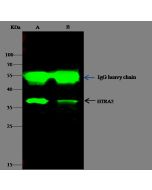
Recombinant Human IL1RL1 protein (Catalog#10105-H08H)
Preparation
Produced in rabbits immunized with purified, recombinant Human IL1RL1 extracellular domain (rhIL1RL1; Catalog#10105-H08H; Met1-Phe328; NP_003847.2). IL1RL1 specific IgG was purified by human IL1RL1 affinity chromatography.
Source
Polyclonal Rabbit IgG
Purification
Protein A & Antigen Affinity
Formulation
0.2 μm filtered solution in PBS
Conjugate
Unconjugated
Form
Liquid
Shipping
This antibody is shipped as liquid solution at ambient temperature. Upon receipt, store it immediately at the temperature recommended below.
Storage
This antibody can be stored at 2℃-8℃ for one month without detectable loss of activity. Antibody products are stable for twelve months from date of receipt when stored at -20℃ to -80℃. Preservative-Free. Avoid repeated freeze-thaw cycles.
IL-1 receptor–like 1 (IL1RL1) is a membrane receptor involved in TH2 inflammatory responses and eosinophilia. It has previously been described that levels of the interleukin-1 like 1 (IL1RL1) protein can be used to diagnose cardiovascular disease and determine the prognosis for a patient with cardiovascular disease. The ligand for IL1RL1 has been described and named IL-33. Mutants in IL1RL1 have been associated with blood eosinophil counts in a genome-wide association study and with asthma in family-based and case-control studies. As an important mediator involved in many immune and inflammatory responses, this cytokine has been implicated as a regulator of both the development and effector phases of type 2 helper T cell responses, and as a negative feedback modulator of macrophage proinflammatory function. IL33 is a specific ligand of ST2L and induces the production of Th2 cytokines.
Related Pathways
IL1 signaling pathway
References
Savenije OE, et al. (2011) Interleukin-1 receptor-like 1 polymorphisms are associated with serum IL1RL1-a, eosinophils, and asthma in childhood. J Allergy Clin Immunol. 127(3): 750-6.
Li H, et al. (2000) The cloning and nucleotide sequence of human ST2L cDNA. Genomics. 67(3): 284-90.