Produced in rabbits immunized with E. coli-derived Human IL-23 P19 / IL23A fragment, and purified by antigen affinity chromatography.
Source
Polyclonal Rabbit IgG
Purification
Protein A & Antigen Affinity
Formulation
PBS, pH7.0 with 0.03% Proclin300
Conjugate
Unconjugated
Form
Liquid
Shipping
This antibody is shipped as liquid solution at ambient temperature. Upon receipt, store it immediately at the temperature recommended below.
Storage
This antibody can be stored at 2℃-8℃ for one month without detectable loss of activity. Antibody products are stable for twelve months from date of receipt when stored at -20℃ to -80℃. Avoid repeated freeze-thaw cycles.
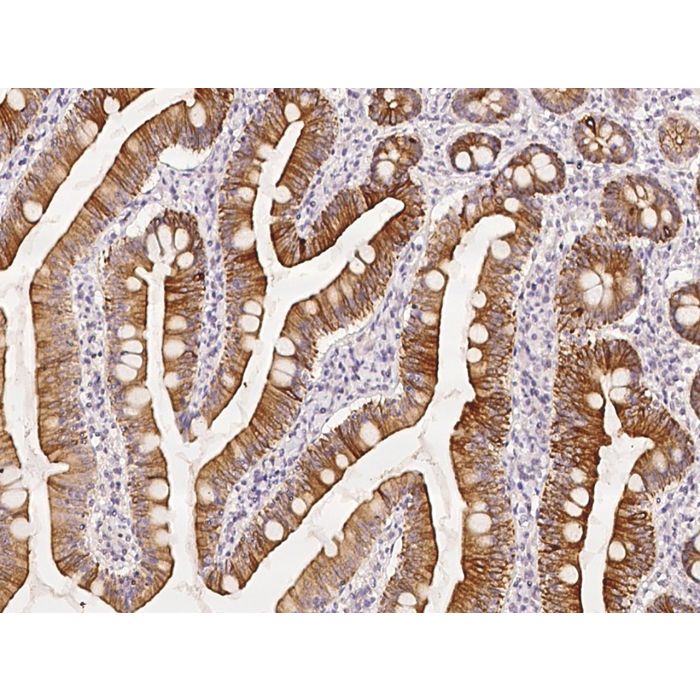
Immunochemical staining of human IL23A in human small intestine with rabbit polyclonal antibody at 1:500 dilution, formalin-fixed paraffin embedded sections.
Image 1 Alt Text
Human IL-23 P19 / IL23A Immunohistochemistry(IHC) 29760
IL-23, which is mainly secreted by antigen-presenting cells, is a member of the IL-12 family, which includes IL-12, IL-27, and IL-35. IL-23 is a heterodimeric cytokine, comprised of a unique p19 subunit and p4 subunit, the latter of which is shared with IL-12. The receptor for IL-23 consists of IL-23R and IL-12Rβ1, the latter of which is also characteristic of IL-12. IL-23 is essential for Th17 differentiation, expansion, and survival by binding to its receptor, thereby activating the signaling pathway. Many studies revealed that the IL-23/Th17 pathway is implicated in the pathophysiology of various autoimmune diseases, such as autoimmune arthritis, primary biliary cirrhosis, and inflammatory bowel disease.
Research Areas
Neuroinflammation
Tags
Cancer Immunotherapy
Immune Checkpoint
Immunotherapy
Targeted Therapy
References
Ye X, Zhang L, Wang H, et al. The Role of IL-23/Th17 Pathway in Patients with Primary Immune Thrombocytopenia. Kuwana M, ed. PLoS ONE. 2015;10(1):e0117704.