Produced in rabbits immunized with E. coli-derived Human KRT10 fragment, and purified by antigen affinity chromatography.
Source
Polyclonal Rabbit IgG
Purification
Protein A & Antigen Affinity
Formulation
PBS, pH7.0 with 0.03% Proclin300
Conjugate
Unconjugated
Form
Liquid
Shipping
This antibody is shipped as liquid solution at ambient temperature. Upon receipt, store it immediately at the temperature recommended below.
Storage
This antibody can be stored at 2℃-8℃ for one month without detectable loss of activity. Antibody products are stable for twelve months from date of receipt when stored at -20℃ to -80℃. Avoid repeated freeze-thaw cycles.
KRT10 was identified as a differently expressed protein in cisplatin-treated C13K/PTEN cells. Further study confirmed that cisplatin could induce upregulation of KRT10 mRNA and protein in C13K/PTEN cells and there was a direct interaction between KRT10 and PTEN. KRT10 is a downstream molecule of PTEN which improves cisplatin-resistance of ovarian cancer and forced KRT10 overexpression may also act as a therapeutic method for overcoming MDR in ovarian cancer. The substitution of arginine (R) to histidine (H) at amino acid residue 156 (R156H) of the coiled 1A region is one of the most frequent mutations of KRT10. Ichthyosis with confetti (IWC) is a genodermatosis caused by dominant-negative mutations in the gene encoding keratin 10 (KRT10). Recombinant adenovirus-mediated overexpression of KRT10 and PTEN may improve the cisplatin resistance of ovarian cancer in vitro and in vivo.
References
Wu H, et al. (2015) Recombinant adenovirus-mediated overexpression of pten and krt10 improves cisplatin resistance of ovarian cancer in vitro and in vivo. Genet Mol Res 14 (2): 6591-6597.
Wu H, et al. (2014) Pten overexpression improves cisplatin-resistance of human ovarian cancer cells through upregulating krt10 expression. Biochem Biophys Res Commun 444 (2): 141-146.
Spoerri I, et al. (2015) The phenotypic and genotypic spectra of ichthyosis with confetti plus novel genetic variation in the 3' end of krt10: From disease to a syndrome. JAMA Dermatol 151 (1): 64-69.
Mayuzumi N, et al. (2000) Recurrent r156h mutation of krt10 in a japanese family with bullous congenital ichthyosiform erythroderma. J Eur Acad Dermatol Venereol 14 (4): 304-306.

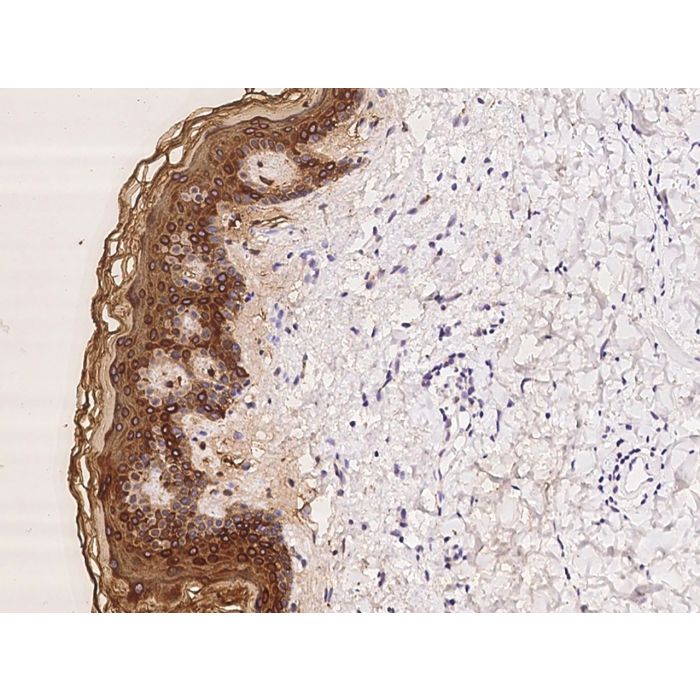


-HD13JL2277-500-human-skin-IHC-P.png)