Recombinant Anti-CD64/FCGR1 Antibody, Rabbit Monoclonal sinobiological 50086-R027
| Catalog No. | Size | Price (USD) |
| 50086-R027-20 | 20 µL | $118.49 |
| 50086-R027-50 | 50 µL | $177.58 |
| 50086-R027-100 | 100 µL | $340.51 |
| Catalog No. | Size | Price (USD) |
| 50086-R027-20 | 20 µL | $118.49 |
| 50086-R027-50 | 50 µL | $177.58 |
| 50086-R027-100 | 100 µL | $340.51 |
General Information
| Product name | Recombinant Anti-CD64/FCGR1 Antibody, Rabbit Monoclonal |
| Validated applications | FCM (FAQ Protocol), ICC/IF (FAQ Protocol) |
| Species reactivity | Reacts with: Mouse |
| Specificity | Mouse CD64/FCGR1 |
| Immunogen | Recombinant Mouse CD64 / FCGR1 protein (Catalog#50086-M08H) |
| Preparation | This antibody was obtained from a rabbit immunized with purified, recombinant Mouse CD64 / FCGR1 (rM CD64 / FCGR1; Catalog#50086-M08H; NP_034316.1; Met1-Pro297). |
| Source | Monoclonal Rabbit IgG Clone #027 |
| Purification | Protein A |
| Formulation | 0.2 μm filtered solution in PBS |
| Conjugate | Unconjugated |
| Form | Liquid |
| Shipping | This antibody is shipped as liquid solution at ambient temperature. Upon receipt, store it immediately at the temperature recommended below. |
| Storage | This antibody can be stored at 2℃-8℃ for one month without detectable loss of activity. Antibody products are stable for twelve months from date of receipt when stored at -20℃ to -80℃. Preservative-Free. Avoid repeated freeze-thaw cycles. |
Synonyms: Anti-CD64 Antibody; Anti-Fcg1 Antibody; Anti-FcgammaRI Antibody; Anti-Fcgr1 Antibody; Anti-IGGHAFC Antibody
Image / Experimental Information
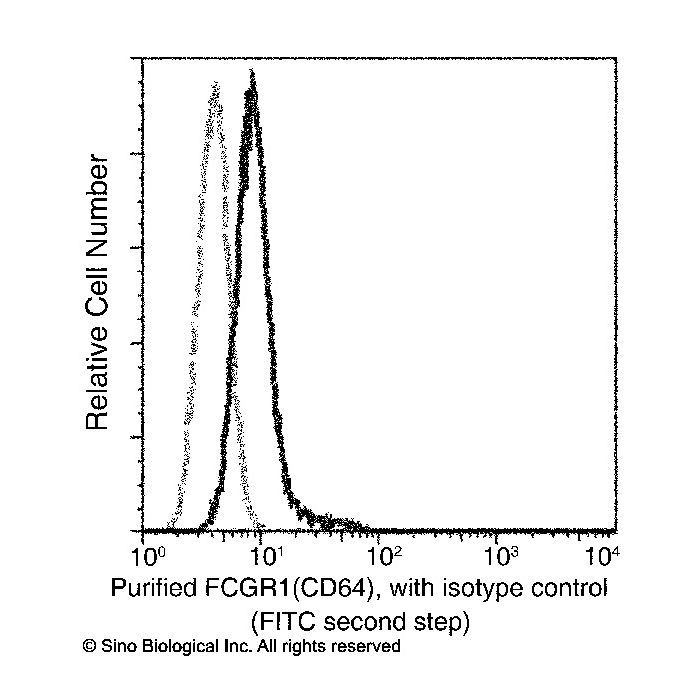
| Image 1 Description | Flow cytometric analysis of Mouse FCGR1(CD64) expression on Raw264.7 cells. Cells were stained with purified anti-Mouse FCGR1(CD64), then a FITC-conjugated second step antibody. The fluorescence histograms were derived from gated events with the forward and side light-scatter characteristics of intact cells. |
| Image 1 Alt Text | Mouse CD64/Fc gamma RI Flow Cytometry (FC) 14791 |
| Image 1 URL | Source image |
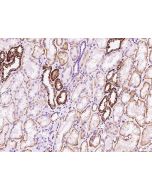
| Image 2 Description | Flow cytometric analysis of Mouse FCGR1(CD64) expression on Raw264.7 cells. Cells were stained with purified anti-Mouse FCGR1(CD64), then a FITC-conjugated second step antibody. The fluorescence histograms were derived from gated events with the forward and side light-scatter characteristics of intact cells. |
| Image 2 Alt Text | Mouse CD64 Immunofluorescence(IF) 19011 |
| Image 2 URL | Source image |
Background Information
| Full Name | Fc receptor, IgG, high affinity I |
| Description | High affinity immunoglobulin gamma Fc receptor I, also known as FCGR1 and CD64, is an integral membraneglycoprotein and a member of the immunoglobulin superfamily. CD64 is a high affinity receptor for the Fc region of IgG gamma and functions in both innate and adaptive immune responses. Receptors that recognize the Fc portion of IgG function in the regulation of immune response and are divided into three classes designated CD64, CD32, and CD16. CD64 is structurally composed of asignal peptidethat allows its transport to the surface of a cell, threeextracellularimmunoglobulin domainsof the C2-type that it uses to bind antibody, a hydrophobictransmembrane domain, and a short cytoplasmic tail. CD64 isconstitutivelyfound on only macrophages and monocytes, but treatment of polymorphonuclear leukocyteswith cytokines likeIFNγandG-CSFcan induce CD64 expression on these cells. The inactivation of the mouse CD64 resulted in a wide range of defects in antibody Fc-dependent functions. Mouse CD64 is an early participant in Fc-dependent cell activation and in the development of immune responses. |
| Research Areas |
|
| References |
|
title: Sex shapes CD64 expression and vaccine-induced monocytic responses
authors: Charlotte Sophie Hansen; Julie Sellau; ...; Hanna Lotter
journal: Biology of Sex Differences
date: 2026-04-05
pmid: 41937154
cited_by_count: 0
bioz_score: 94
title: An Immunoreceptor-Targeting Strategy with Minimalistic C3b Peptide Fusion Enhances SARS-CoV-2 RBD mRNA Vaccine Immunogenicity
authors: Chun-Ta Chiu; Hsiao-Han Tsai; ...; Hui-Wen Chen
journal: International Journal of Nanomedicine
date: 2024-07-01
doi: 10.2147/ijn.s463546
cited_by_count: 0
techniques: Binding Assay; Expressing; Fluorescence; Incubation; Microscopy; Recombinant; Staining; Transfection
bioz_score: 93
title: Interplay between CXCR4 and CCR2 regulates bone marrow exit of dendritic cell progenitors.
authors: Mariana Pereira da Costa; Carlos M Minutti; ...; Caetano Reis E Sousa
journal: Cell Reports
date: 2023-09-27
pmid: 37523265
doi: 10.1016/j.celrep.2023.112881
cited_by_count: 8
bioz_score: 94
title: A CD64/FcγRI-mediated mechanism hijacks PD-1 from PD-L1/2 interaction and enhances anti-PD-1 functional recovery of exhausted T cells
authors: Victor Joo; Constantinos Petrovas; ...; Giuseppe Pantaleo
journal: Frontiers in Immunology
date: 2023-08-09
pmid: 37622123
doi: 10.3389/fimmu.2023.1213375
pmcid: 10446174
cited_by_count: 5
techniques: Control; Expressing; Incubation; Infection; Isolation; Plasmid Preparation; Purification; Staining; Transfection; Two Tailed Test
bioz_score: 94
title: Selective depletion of a CD64-expressing phagocyte subset mediates protection against toxic kidney injury and failure
authors: Natallia Salei; Xingqi Ji; ...; Barbara U. Schraml
journal: Proceedings of the National Academy of Sciences of the United States of America
date: 2021-09-28
pmid: 34518373
doi: 10.1073/pnas.2022311118
pmcid: 8488624
cited_by_count: 8
bioz_score: 94
title: The Kidney Contains Ontogenetically Distinct Dendritic Cell and Macrophage Subtypes throughout Development That Differ in Their Inflammatory Properties
authors: Natallia Salei; Stephan Rambichler; ...; Barbara U. Schraml
journal: Journal of the American Society of Nephrology : JASN
date: 2020-02-01
pmid: 31932472
doi: 10.1681/ASN.2019040419
pmcid: 7003301
cited_by_count: 44
techniques: Cytometry; Derivative Assay; Expressing; Flow Cytometry; Fluorescence; Imaging; Immunofluorescence; In Vitro; Injection; Isolation; Labeling; Marker; Microscopy; Positive Control; Staining
bioz_score: 94
title: SHR-A1403, a novel c-Met antibody-drug conjugate, exerts encouraging anti-tumor activity in c-Met-overexpressing models
authors: Chang-yong Yang; Lei Wang; ...; Shao-hua Gou
journal: Acta pharmacologica Sinica
date: 2019-07-01
pmid: 30643210
doi: 10.1038/s41401-018-0198-0
pmcid: 6786420
cited_by_count: 30
techniques: Binding Assay; Derivative Assay; In Vitro
bioz_score: 94