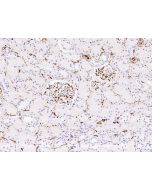
Recombinant Mouse CHL1 / LICAM2 / CALL Protein (Catalog#51176-M08H)
Preparation
Produced in rabbits immunized with purified, recombinant Mouse CHL1 / LICAM2 / CALL (rM CHL1 / LICAM2 / CALL; Catalog#51176-M08H; ; Met1-Gln1027). CHL1 / LICAM2 / CALL specific IgG was purified by Mouse CHL1 / LICAM2 / CALL affinity chromatography.
Source
Polyclonal Rabbit IgG
Purification
Protein A & Antigen Affinity
Formulation
0.2 μm filtered solution in PBS
Conjugate
Unconjugated
Form
Liquid
Shipping
This antibody is shipped as liquid solution at ambient temperature. Upon receipt, store it immediately at the temperature recommended below.
Storage
This antibody can be stored at 2℃-8℃ for one month without detectable loss of activity. Antibody products are stable for twelve months from date of receipt when stored at -20℃ to -80℃. Preservative-Free. Avoid repeated freeze-thaw cycles.
Neural cell adhesion molecule L1-like protein, also known as close homolog of L1 (CHL1) is the prototypic member of the CTF / NF-1 family of transcription factors that serve as a novel calcium signaling pathway-responsive transcription factor and is considered as a member of the largest ctf complementation group, consisting of 30 of 126 ctf mutants isolated. CHL1 is a cell adhesion molecule highly related to L1. It contains structure plan of six extracellular C2-type immunoglobulin (Ig) domains followed by five fibronectin type Ⅲ domains linked by a single membrane-spanning region to a short cytoplasmic domain. The extracellular portion of CHL1 is higyly glycosylated and involved in hemophilic disease.
References
Alevizopoulos A, et al. (1997) Regulation of the Transforming Growth Factor beta-responsive Transcription Factor CTF-1 by Calcineurin and Calcium/ Calmodulin-dependent Protein Kinase IV. The Journal of Biological Chemistry. 272: 23597-605.
Gerring SL, et al. (1990) The CHL1 (CTF 1) gene product of Saccharomyces cerevisiae is important for chromosome transmission and normal cell cycle progression in G2 / M. EMBO J. 9 (13): 4347-58.
Wei MH, et al. (1998) In silico-initiated cloning and molecular characterization of a novel human member of the L1 gene family of neural cell adhesion molecules. Human Genetics. 103 (3): 355-64.