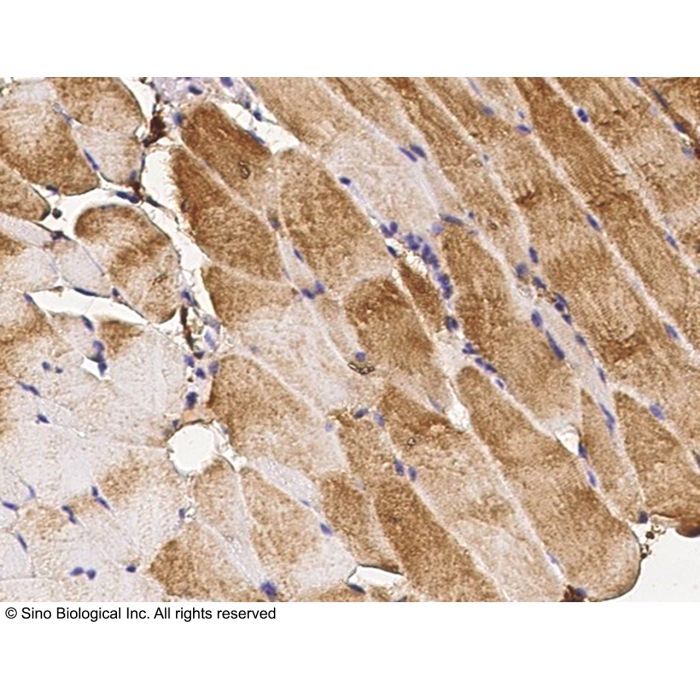
Recombinant Mouse CHST3 / C6ST-1 Protein (Catalog#50577-M07H)
Preparation
Produced in rabbits immunized with purified, recombinant Mouse CHST3 / C6ST-1 (rM CHST3 / C6ST-1; Catalog#50577-M07H; NP_058083.2; Glu39-Thr472). CHST3 / C6ST-1 specific IgG was purified by Mouse CHST3 / C6ST-1 affinity chromatography.
Source
Polyclonal Rabbit IgG
Purification
Protein A & Antigen Affinity
Formulation
0.2 μm filtered solution in PBS
Conjugate
Unconjugated
Form
Liquid
Shipping
This antibody is shipped as liquid solution at ambient temperature. Upon receipt, store it immediately at the temperature recommended below.
Storage
This antibody can be stored at 2℃-8℃ for one month without detectable loss of activity. Antibody products are stable for twelve months from date of receipt when stored at -20℃ to -80℃. Preservative-Free. Avoid repeated freeze-thaw cycles.
Carbohydrate sulfotransferase 3, also known as Chondroitin 6-O-sulfotransferase 1, Chondroitin 6-sulfotransferase and CHST3, is a single-pass type II membrane protein which belongs to thesulfotransferase 1 family and Gal / GlcNAc / GalNAc subfamily. CHST3 is widely expressed in adult tissues. It is expressed in heart, placenta, skeletal muscle and pancreas. CHST3 is also expressed in various immune tissues such as spleen, lymph node, thymus and appendix. CHST3 catalyzes the transfer of sulfate to position 6 of the N-acetylgalactosamine (GalNAc) residue of chondroitin. It is a chondroitin sulfate which constitutes the predominant proteoglycan present in cartilage and is distributed on the surfaces of many cells and extracellular matrices. It can also sulfate Gal residues of keratan sulfate, another glycosaminoglycan, and the Gal residues in sialyl N-acetyllactosamine (sialyl LacNAc) oligosaccharides. It may play a role in the maintenance of naive T-lymphocytes in the spleen. Defects in CHST3 are the cause of spondyloepiphyseal dysplasia Omani type (SED Omani type) which is an autosomal recessive disorder characterized by normal length at birth but severely reduced adult height (11-13 cm), severe progressive kyphoscoliosis, arthritic changes with joint dislocations, genu valgum, cubitus valgus, mild brachydactyly, camptodactyly, microdontia and normal intelligence. As a consequence of the arthropathy and the contractures, affected individuals develop restricted joint movement. Defects in CHST3 are also a cause of humerospinal dysostosis (HSD) which is characterized by bifurcation of the ends of the humerus, subluxation in the elbow joints, widened iliac bones, talipes equinovarus and coronal cleft vertebrae. Congenital, progressive heart disease, possibly with fatal outcome, is observed in some patients.
References
Fukuta M., et al., 1998, Biochim. Biophys. Acta 1399:57-61.
Tsutsumi K., et al., 1998, FEBS Lett. 441:235-241.
Thiele H., et al., 2004, Proc. Natl. Acad. Sci. USA. 101:10155-10160.
Hermanns P., et al., 2008, Am. J. Hum. Genet. 82:1368-1374.