Recombinant Mouse ICAM-1 protein (Catalog#50440-M08H)
Preparation
This antibody was obtained from a rabbit immunized with purified, recombinant Mouse CD54 / ICAM1 (rM CD54 / ICAM1; Catalog#50440-M08H; NP_034623.1; Met 1-Asn 485) and conjugated with PE under optimum conditions, the unreacted PE was removed.
Source
Monoclonal Rabbit IgG Clone #009
Purification
Protein A
Formulation
PBS solution containing 0.5% BSA and 0.1% sodium azide
Concentration
10 μl/Test, 0.1 mg/ml
Conjugate
PE
Form
Liquid
Shipping
This antibody is shipped as liquid solution at ambient temperature. Upon receipt, store it immediately at the temperature recommended below.
Storage
This antibody can be stored at 2℃-8℃ for twelve months without detectable loss of activity. Protected from prolonged exposure to light. Do not freeze ! Sodium azide is toxic to cells and should be disposed of properly. Flush with large volumes of water during disposal.
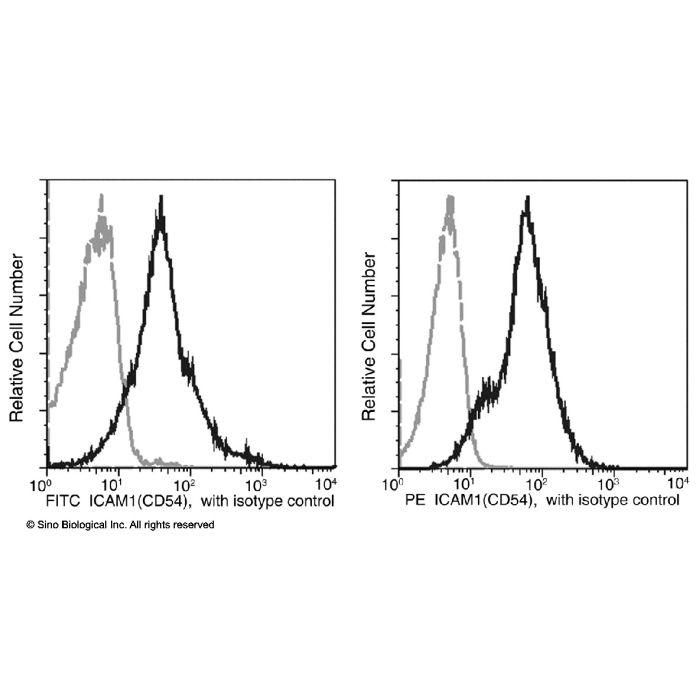
Analysis of ICAM1 (CD54) expression on spleen lymphocytes. Naive BALB/c splenocytes were treated with Mouse BD Fc Block™ purified anti-CD16/CD32 mAb 2.4G2 (Cat. No. 553141) and stained with PE-conjugated anti-Mouse ICAM1 (CD54) (50440-R009-P). The histogram were derived from the gated events based on light scattering characteristics of lymphocytes.
Intercellular adhesion molecule-1 (ICAM-1, or CD54) is a 90 kDa member of the immunoglobulin (Ig) superfamily and is critical for the firm arrest and transmigration of leukocytes out of blood vessels and into tissues. ICAM-1 is constitutively present on endothelial cells, but its expression is increased by proinflammatory cytokines. The endothelial expression of ICAM-1 is increased in atherosclerotic and transplant-associated atherosclerotic tissue and animal models of atherosclerosis. Additionally, ICAM-1 has been implicated in the progression of autoimmune diseases. ICAM-1 is a ligand for LFA-1(integrin). When activated, leukocytes bind to endothelial cells via ICAM-1/LFA-1 interaction and then transmigrate into tissues. Presence with heavy glycosylation and other structural characteristics, ICAM-1 possesses binding sites for some immune-associated ligands and serves as the binding site for entry of the major group of human Rhinovirus (HRV) into various cell types. ICAM-1 also becomes known for its affinity for Plasmodium falciparum-infected erythrocytes (PFIE), providing more of a role in infectious disease. Previous studies have shown that ICAM-1 is involved in inflammatory reactions and that a defect in ICAM-1 gene inhibits allergic contact hypersensitivity.
Research Areas
Neuroinflammation
References
Xu H, et al. (2001) The role of ICAM-1 molecule in the migration of Langerhans cells in the skin and regional lymph node. Eur J Immunol. 31(10): 3085-93.
Terol MJ, et al. (2003) Soluble intercellular adhesion molecule-1 (s-ICAM-1/s-CD54) in diffuse large B-cell lymphoma: association with clinical characteristics and outcome. Ann Oncol. 14(3): 467-74.
Mendez MP, et al. (2006) Shedding of soluble ICAM-1 into the alveolar space in murine models of acute lung injury. Am J Physiol Lung Cell Mol Physiol. 290(5): L962-70.
Lawson C, et al. (2009) ICAM-1 signaling in endothelial cells. Pharmacol Rep. 61(1): 22-32.


-R009-FITC-PE-splenocyte.png)