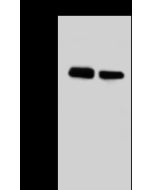
E. coli-derived Human Myosin light chain 3 / MYL3 fragment
Preparation
Produced in rabbits immunized with E. coli-derived Human Myosin light chain 3 / MYL3 fragment, and purified by antigen affinity chromatography.
Source
Polyclonal Rabbit IgG
Purification
Protein A & Antigen Affinity
Formulation
PBS, pH7.0 with 0.03% Proclin300
Conjugate
Unconjugated
Form
Liquid
Shipping
This antibody is shipped as liquid solution at ambient temperature. Upon receipt, store it immediately at the temperature recommended below.
Storage
This antibody can be stored at 2℃-8℃ for one month without detectable loss of activity. Antibody products are stable for twelve months from date of receipt when stored at -20℃ to -80℃. Avoid repeated freeze-thaw cycles.
Immunochemical staining of human MYL3 in human skeletal muscle with rabbit polyclonal antibody at 1:500 dilution, formalin-fixed paraffin embedded sections.
Image 1 Alt Text
Human Myosin light chain 3 / MYL3 Immunohistochemistry(IHC) 26346
Immunochemical staining of human MYL3 in human skeletal muscle with rabbit polyclonal antibody at 1:500 dilution, formalin-fixed paraffin embedded sections.
Image 2 Alt Text
Human Myosin light chain 3 / MYL3 Immunohistochemistry(IHC) 26347
MYL3 (Myosin Light Chain 3) is a Protein Coding gene. MYL3 encodes myosin light chain 3, an alkali light chain also referred to in the literature as both the ventricular isoform and the slow skeletal muscle isoform. Myosin is a hexameric contractile protein composed of 2 heavy chains associated with 4 light chains of 2 distinct classes - 2 regulatory light chains (MYL2) and 2 essential light chains (MYL3). Mutations in genes encoding cardiac sarcomeric proteins are thought to be a very rare cause of hypertrophic cardiomyopathy (HCM) in infants and young children. A 3-month-old infant presenting with severe progressive HCM arising from a mutation in the gene encoding the essential light chain of myosin (MYL3). Diseases associated with MYL3 include Cardiomyopathy, Familial Hypertrophic, 8, and Hypertrophic Cardiomyopathy.