Influenza A H7N7 (A/Netherlands/219/2003) Neuraminidase / NA Antibody, Rabbit PAb, Antigen Affinity Purified
Validated applications
WB (FAQ Protocol), ELISA (FAQ Protocol)
Application notes
IHC, FCM, IF, IP et al. applications haven't been validated. (Antibody's applications haven't been validated with corresponding virus positive samples. Optimal concentrations/dilutions should be determined by the end user.)
Specificity
Influenza A H7N7 (A/Netherlands/219/2003) Neuraminidase / NA
Immunogen
Recombinant Influenza A H7N7 (A/Netherlands/219/2003) Neuraminidase / NA Protein (Catalog#40202-V07H)
Preparation
Produced in rabbits immunized with purified, recombinant Influenza A H7N7 (A/Netherlands/219/2003) Neuraminidase / NA (Catalog#40202-V07H; AAR11367.1; His36-Ser471). Influenza A H7N7 (A/Netherlands/219/2003) Neuraminidase / NA specific IgG was purified by Influenza A H7N7 (A/Netherlands/219/2003) Neuraminidase / NA affinity chromatography.
Source
Polyclonal Rabbit IgG
Purification
Protein A & Antigen Affinity
Formulation
0.2 μm filtered solution in PBS
Conjugate
Unconjugated
Form
Liquid
Shipping
This antibody is shipped as liquid solution at ambient temperature. Upon receipt, store it immediately at the temperature recommended below.
Storage
This antibody can be stored at 2℃-8℃ for one month without detectable loss of activity. Antibody products are stable for twelve months from date of receipt when stored at -20℃ to -80℃. Preservative-Free. Avoid repeated freeze-thaw cycles.
Image / Experimental Information
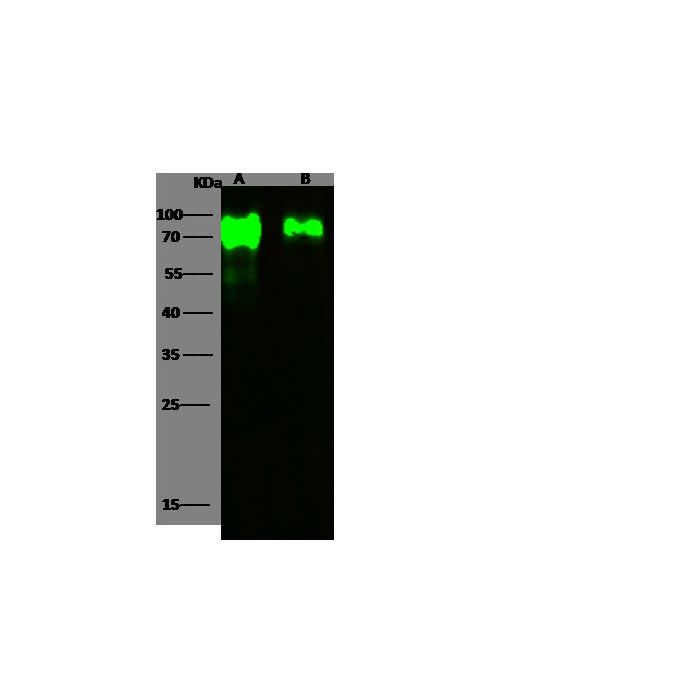
Image 1 Description
Anti-Influenza A H7N7 (A/Netherlands/219/2003) Neuraminidase / NA rabbit polyclonal antibody at 1:1000 dilution. Sample:Influenza A H7N7 (A/Netherlands/219/2003) Neuraminidase / NA Recombinant Protein Lane A: 5ng Lane B: 1ng Secondary Goat Anti- Rabbit IgG H&L (Dylight 800) at 1/10000 dilution. Developed using the Odyssey technique. Performed under reducing conditions.
Neuraminidases are enzymes that cleave sialic acid groups from glycoproteins. Influenza neuraminidase is a type of neuraminidase found on the surface of influenza viruses that enables the virus to be released from the host cell. Influenza neuraminidase is composed of four identical subunits arranged in a square. It is normally attached to the virus surface through a long protein stalk. The active sites are in a deep depression on the upper surface. They bind to polysaccharide chains and clip off the sugars at the end. The surface of neuraminidase is decorated with several polysaccharide chains that are similar to the polysaccharide chains that decorate our cell surface proteins. Neuraminidase (NA) and hemagglutinin (HA) are major membrane glycoproteins found on the surface of the influenza virus. Hemagglutinin binds to the sialic acid-containing receptors on the surface of host cells during initial infection and at the end of an infectious cycle. Neuraminidase, on the other hand, cleaves the HA-sialic acid bondage from the newly formed virions and the host cell receptors during budding. Neuraminidase thus is described as a receptor-destroying enzyme that facilitates virus release and efficient spread of the progeny virus from cell to cell. Influenza antibody and influenza antibodies are very important research tools for influenza diagnosis, influenza vaccine development, and anti-influenza virus therapy development. The monoclonal or polyclonal antibody can be raised with protein based antigen or peptide-based antigen. Antibodies raised with protein-based antigen could have better specificity and/or binding affinity than antibodies raised with peptide based antigen, but the cost associated with the recombinant protein antigen is usually higher. Anti-influenza virus hemagglutinin (HA) monoclonal antibody or polyclonal antibody can be used for ELISA assay, western blotting detection, Immunohistochemistry (IHC), flow cytometry, neutralization assay, hemagglutinin inhibition assay, and early diagnosis of influenza viral infection. Sino Biological has developed state-of-the-art monoclonal antibody development technology platforms: mouse monoclonal antibody and rabbit monoclonal antibody. Our rabbit monoclonal antibody platform is one of a kind and offers some unique advantages over mouse monoclonal antibodies, such as high affinity, low cross-reactivity with rabbit polyclonal antibodies.
References
Sardet C., et al. ,(1989), Molecular cloning, primary structure, and expression of the human growth factor-activatable Na+/H+ antiporter. Cell 56:271-280.
Sardet C., et al. , (1990), Growth factors induce phosphorylation of the Na+/H+ antiporter, glycoprotein of 110 kD.Science 247:723-726.
Tse C.-M., et al. ,(1991), Molecular cloning and expression of a cDNA encoding the rabbit ileal villus cell basolateral membrane Na+/H+ exchanger.EMBO J. 10:1957-1967.




-HD09MY0410-WB.png)