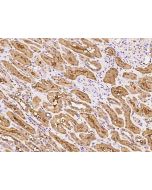
Recombinant Human B7-H1 / CD274 / PD-L1 protein (Catalog#10084-H08H)
Preparation
Produced in rabbits immunized with purified, recombinant Human B7-H1 / CD274 / PD-L1 (rh B7-H1; Catalog#10084-H08H; NP_054862.1; Met 1-Thr 239). B7-H1 specific IgG was purified by Human B7-H1 affinity chromatography and then biotinylated.
Source
Polyclonal Rabbit IgG
Purification
Protein A & Antigen Affinity
Formulation
0.2 μm filtered solution in PBS
Conjugate
Biotin
Form
Liquid
Shipping
This antibody is shipped as liquid solution at ambient temperature. Upon receipt, store it immediately at the temperature recommended below.
Storage
This antibody can be stored at 2℃-8℃ for one month without detectable loss of activity. Antibody products are stable for twelve months from date of receipt when stored at -20℃ to -80℃. Preservative-Free. Avoid repeated freeze-thaw cycles.
Programmed death-1 ligand-1 (PD-L1, CD274, B7-H1) has been identified as the ligand for the immunoinhibitory receptor programmed death-1(PD1/PDCD1) and has been demonstrated to play a role in the regulation of immune responses and peripheral tolerance. PD-L1/B7-H1 is a member of the growing B7 family of immune molecules and this protein contains one V-like and one C-like Ig domain within the extracellular domain, and together with PD-L2, are two ligands for PD1 which belongs to the CD28/CTLA4 family expressed on activated lymphoid cells. By binding to PD1 on activated T-cells and B-cells, PD-L1 may inhibit ongoing T-cell responses by inducing apoptosis and arresting cell-cycle progression. Accordingly, it leads to growth of immunogenic tumor growth by increasing apoptosis of antigen specific T cells and may contribute to immune evasion by cancers. PD-L1 thus is regarded as promising therapeutic target for human autoimmune disease and malignant cancers.
Research Areas
Cancer Drug Targets
Tags
Cancer Immunotherapy
Co-inhibitory Immune Checkpoint Targets
Immune Checkpoint
Immune Checkpoint Blockade: Blocking Antibodi
Immune Checkpoint Blockade: PD-L1 / B7-H1 / C
Immune Checkpoint Detection: Antibodies
Immune Checkpoint Detection: ELISA Antibodies
Immune Checkpoint Detection: FCM Antibodies
Immune Checkpoint Detection: ICC Antibodies
Immune Checkpoint Detection: IHC Antibodies
Immune Checkpoint Detection: WB Antibodies
Immune Checkpoint Proteins
Immune Checkpoint Targets
Immunotherapy
PD-L1 / B7-H1 / CD274 Immune Checkpoint Prote
Targeted Therapy
References
Iwai Y, et al. (2002) Involvement of PD-L1 on tumor cells in the escape from host immune system and tumor immunotherapy by PD-L1 blockade. Proc Natl Acad Sci U S A. 99(19): 12293-7.
Ghebeh H, et al. (2006) The B7-H1 (PD-L1) T lymphocyte-inhibitory molecule is expressed in breast cancer patients with infiltrating ductal carcinoma: correlation with important high-risk prognostic factors. Neoplasia. 8(3): 190-8.
Salih HR, et al. (2006) The role of leukemia-derived B7-H1 (PD-L1) in tumor-T-cell interactions in humans. Exp Hematol. 34(7): 888-94.
Wilcox RA, et al. (2009) B7-H1 (PD-L1, CD274) suppresses host immunity in T-cell lymphoproliferative disorders. Blood. 114(10): 2149-58.
Ruggiero A, et al. (2009) Crystal structure of PD-L1, a ribosome inactivating protein from Phytolacca dioica L. leaves with the property to induce DNA cleavage. Biopolymers. 91(12): 1135-42.
title: Anti-PD-1 antibody, antigen-binding fragment thereof and pharmaceutical use thereof authors: Xiaoling Gu; Xin Ye; ...; Weikang Tao date: 2025-09-30 cited_by_count: 0 techniques: Binding Assay; Concentration Assay; Enzyme-linked Immunosorbent Assay; In Vitro; Incubation bioz_score: 93
title: The Generation of Dual-Targeting Fusion Protein PD-L1/CD47 for the Inhibition of Triple-Negative Breast Cancer authors: Yanlin Bian; Tong Lin; ...; Satoshi Wada journal: Biomedicines date: 2022-07-30 pmcid: 9405206 cited_by_count: 2 techniques: Binding Assay; Expressing; Flow Cytometry; In Vitro; Incubation; Positive Control; Software bioz_score: 93