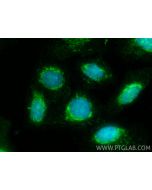
GLO1 Polyclonal antibody 15140-1-AP proteintech
$149.00
In stock
SKU
15140-1-AP
| Catalog Number | 15140-1-AP |
| Synonyms | EC:4.4.1.5, ELNR1, GLOD1, Glx I, GLYI |
| Host | Rabbit |
| Reactivity | human, mouse, rat |
| Form | Liquid |
| Formulation | PBS, Azide, Glycerol |
| Applications | WB, IHC, IF, IP, ELISA |
| Applications | WB, IHC, IP, ELISA |
| Host / Isotype | Rabbit / IgG |
| Tested Applications — Positive WB detected in | Raji cells, HEK-293 cells, HeLa cells, rat liver tissue, HepG2 cells, mouse liver tissue |
| Tested Applications — Positive IP detected in | HepG2 cells |
| Tested Applications — Positive IHC detected in | human thyroid cancer tissue Note: suggested antigen retrieval with TE buffer pH 9.0; (*) Alternatively, antigen retrieval may be performed with citrate buffer pH 6.0 |
| Recommended Dilutions — Western Blot (WB) | WB : 1:2000-1:10000 |
| Recommended Dilutions — Immunoprecipitation (IP) | IP : 0.5-4.0 ug for 1.0-3.0 mg of total protein lysate |
| Recommended Dilutions — Immunohistochemistry (IHC) | IHC : 1:200-1:1000 |
| Positive WB detected in | Raji cells, HEK-293 cells, HeLa cells, rat liver tissue, HepG2 cells, mouse liver tissue |
| Positive IP detected in | HepG2 cells |
| Positive IHC detected in | human thyroid cancer tissue Note: suggested antigen retrieval with TE buffer pH 9.0; (*) Alternatively, antigen retrieval may be performed with citrate buffer pH 6.0 |
| Western Blot (WB) | WB : 1:2000-1:10000 |
| Immunoprecipitation (IP) | IP : 0.5-4.0 ug for 1.0-3.0 mg of total protein lysate |
| Immunohistochemistry (IHC) | IHC : 1:200-1:1000 |
| Tested Reactivity | human, mouse, rat |
| Cited Reactivity | human, mouse, rat |
| Class | Polyclonal |
| Type | Antibody |
| Immunogen | CatNo: Ag7314 Product name: Recombinant human GLO1 protein Source: e coli. -derived, PET28a Tag: 6*His Domain: 1-184 aa of BC001741 Sequence: MAEPQPPSGGLTDEAALSCCSDADPSTKDFLLQQTMLRVKDPKKSLDFYTRVLGMTLIQKCDFPIMKFSLYFLAYEDKNDIPKEKDEKIAWALSRKATLELTHNWGTEDDETQSYHNGNSDPRGFGHIGIAVPDVYSACKRFEELGVKFVKKPDDGKMKGLAFIQDPDGYWIEILNPNKMATLM Predict reactive species |
| Full Name | glyoxalase I |
| Calculated Molecular Weight | 21 kDa |
| Observed Molecular Weight | 21-25 kDa |
| GenBank Accession Number | BC001741 |
| Gene Symbol | GLO1 |
| Gene ID (NCBI) | 2739 |
| RRID | AB_2109890 |
| Conjugate | Unconjugated |
| Purification Method | Antigen affinity purification |
| UNIPROT ID | Q04760 |
| Storage Buffer | PBS with 0.02% sodium azide and 50% glycerol, pH 7.3. |
| Storage Conditions | Store at -20°C. Stable for one year after shipment. Aliquoting is unnecessary for -20 o C storage. 20ul sizes contain 0.1% BSA. |
| IHC protocol for GLO1 antibody 15140-1-AP | Download protocol |
| IP protocol for GLO1 antibody 15140-1-AP | Download protocol |
| WB protocol for GLO1 antibody 15140-1-AP | Download protocol |
| human | WB Oncotarget Glyoxalase 1 gene is highly expressed in basal-like human breast cancers and contributes to survival of ALDH1-positive breast cancer stem cells. Authors - Shoma Tamori KD Validated View Article |
| mouse | WB Life Sci Alliance Glycine cleavage system determines the fate of pluripotent stem cells via the regulation of senescence and epigenetic modifications. Authors - Shengya Tian View Article |
| Billie (Verified Customer) (07-10-2021) | Strong band at around 25 kDa. Applications: Western Blot Primary Antibody Dilution: 1:2000 with 10ug protein loaded Cell Tissue Type: Astrocytes |
| Citations | 18 |
| Dilutions | WB : 1:2000-1:10000 IP : 0.5-4.0 ug for IP and 0.5-4.0 ug for 1.0-3.0 mg of total protein lysate for WB IHC : 1:200-1:1000 |
| Isotype | IgG |
| Clonality | Polyclonal |
| Clone Number | - |
| Conjugation | Unconjugated |
Glo1 is known to play a role in many diseases including diabetes mellitus, Alzheimer's disease, and cancer. The molecular mass of the dimer was 46 kDa determined by gel permeation chromatography. Protocols Product Specific Protocols IHC protocol for GLO1 antibody 15140-1-AP Download protocol IP protocol for GLO1 antibody 15140-1-AP Download protocol WB protocol for GLO1 antibody 15140-1-AP Download protocol Standard Protocols Click here to view our Standard Protocols
Publications