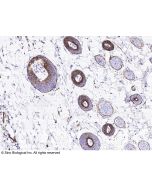
This antibody was obtained from a rabbit immunized with purified, recombinant Rat CD59 (rR CD59; Catalog#80299-R08H; P27274; Met1-Asn100).
Source
Monoclonal Rabbit IgG Clone #001
Purification
Protein A
Formulation
0.2 μm filtered solution in PBS
Conjugate
Unconjugated
Form
Liquid
Shipping
This antibody is shipped as liquid solution at ambient temperature. Upon receipt, store it immediately at the temperature recommended below.
Storage
This antibody can be stored at 2℃-8℃ for one month without detectable loss of activity. Antibody products are stable for twelve months from date of receipt when stored at -20℃ to -80℃. Preservative-Free. Avoid repeated freeze-thaw cycles.
Synonyms: Anti-Cd59 Antibody
Image / Experimental Information
Image 1 Description
Flow cytometric analysis of Rat CD59 expression on SD rat bone marrow cells. Cells were stained with purified anti-Rat CD59, then a FITC-conjugated second step antibody. The fluorescence histograms were derived from gated events with the forward and side light-scatter characteristics of intact cells.
CD59 glycoprotein, also known as 2 kDa homologous restriction factor, HRF2, MAC-inhibitory protein, Membrane attack complex inhibition factor, Membrane inhibitor of reactive lysis, MIC11, MIRL and CD59, is a cell membrane protein which contains one UPAR/Ly6 domain. CD59 is a small, highly glycosylated, GPI-linked protein, with a wide expression profile. The soluble form of CD59 from urine retains its specific complement binding activity, but exhibits greatly reduced ability to inhibit MAC assembly on cell membranes. CD59 is a potent inhibitor of the complement membrane attack complex (MAC) action. CD59 was first identified as a regulator of the terminal pathway of complement. It acts by binding to the C8 and/or C9 complements of the assembling MAC, thereby preventing incorporation of the multiple copies of C9 required for complete formation of the osmolytic pore. This inhibitor appears to be species-specific. CD59 is involved in signal transduction for T-cell activation complexed to a protein tyrosine kinase. Defects in CD59 are the cause of CD59 deficiency (CD59D).
Related Pathways
Complement Activation Pathways
References
Fletcher CM. et al., 1994, Structure. 2: 185-99.
Rudd PM. et al., 1997, J Biol Chem. 272: 7229-44.
Kimberley FC. et al., 2007, Mol Immunol. 44 (1-3): 73-81.
Gong Y. et al., 2007, Sci China C Life Sci. 50 (6): 773-9.
Picariello G. et al., 2008, Proteomics 8: 3833-47.
Heibeck TH. et al., 2009, J Proteome Res. 8: 3852-61.