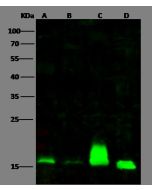
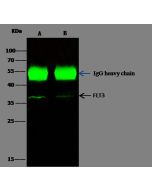
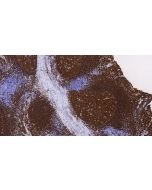
Lyophilized from sterile PBS, pH 7.4. Please contact us for any concerns or special requirements. Normally 5 % - 8 % trehalose, mannitol and 0.01% Tween80 are added as protectants before lyophilization. Please refer to the specific buffer information in the hardcopy of datasheet or the lot-specific COA.
Endotoxin
< 1.0 EU per μg of the protein as determined by the LAL method
Shipping
In general, recombinant proteins are provided as lyophilized powder which are shipped at ambient temperature. Bulk packages of recombinant proteins are provided as frozen liquid. They are shipped out with blue ice unless customers require otherwise.
Stability & Storage
Samples are stable for up to twelve months from date of receipt at -20℃ to -80℃. Store it under sterile conditions at -20℃ to -80℃. It is recommended that the protein be aliquoted for optimal storage. Avoid repeated freeze-thaw cycles.
Reconstitution
To find reconstitution info, click on 'COA' at the top of the page, enter the lot number and product size for the lot-specific COA.
Purity
> 95 % as determined by SDS-PAGE
Activity
Testing in progress
Protein Construction
A DNA sequence encoding the canine CD40LG (O97626) (Met112-Leu260) was expressed with two additional amino acids (Gly & Pro) at the N-terminus.
Accession#
O97626
Expressed Host
HEK293 Cells
Species
Canine
Predicted N Terminal
Gly
Molecule Mass
The recombinant canine CD40LG comprises 151 amino acids and has a predicted molecular mass of 16 kDa. The apparent molecular mass of the protein is approximately 19 kDa in SDS-PAGE under reducing conditions.
The cluster of differentiation (CD) system is commonly used as cell markers in immunophenotyping. Different kinds of cells in the immune system can be identified through the surface CD molecules which associating with the immune function of the cell. There are more than 320 CD unique clusters and subclusters have been identified. Some of the CD molecules serve as receptors or ligands important to the cell through initiating a signal cascade which then alter the behavior of the cell. Some CD proteins do not take part in cell signal process but have other functions such as cell adhesion. CD154, also known as CD40 ligand or CD40L, is a member of the TNF superfamily. While CD154 was originally found on T cell surface, its expression has since been found on a wide variety of cells, including platelets, mast cells, macrophages and NK cells. CD154's ability is achieved through binding to the CD40 on antigen-presenting cells (APC). In the macrophage cells, the primary signal for activation is IFN-γ from Th1 type CD4 T cells. The secondary signal is CD40L on the T cell, which interacting with the CD40 molecules, helping increase the level of activation.
Research Areas
Cancer Drug Targets
Tags
Cancer Immunotherapy
Co-stimulatory Immune Checkpoint Targets
Immune Checkpoint
Immune Checkpoint Detection: Antibodies
Immune Checkpoint Detection: ELISA Antibodies
Immune Checkpoint Detection: WB Antibodies
Immune Checkpoint Proteins
Immune Checkpoint Targets
Immunotherapy
Targeted Therapy
References
Zola H, et al. (2007) CD molecules 2006-human cell differentiation molecules. J Immunol Methods. 318 (1-2): 1-5.
Ho IC, et al. (2009) GATA3 and the T-cell lineage: essential functions before and after T-helper-2-cell differentiation. Nat Rev Immunol. 9 (2): 125-35.
Matesanz-Isabel J, et al. (2011) New B-cell CD molecules. Immunology Letters.134 (2): 104-12.
Grewal IS, et al. (1998) CD40 and CD154 in cell-mediated immunity. Annual Review of Immunology. 16: 111-35.