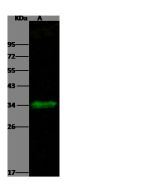
Human IL-3R Beta/IL3RB No cross-reactivity in ELISA with Human cell lysate (293 cell line)
Immunogen
Recombinant Human CSF2RB protein (Catalog#10516-H08H)
Preparation
This antibody was produced from a hybridoma resulting from the fusion of a mouse myeloma with B cells obtained from a mouse immunized with purified, recombinant Human CD131 / CSF2RB / IL3RB / IL5RB (rh CD131 / CSF2RB / IL3RB / IL5RB; Catalog#10516-H08H; NP_000386.1; Met 1-Trp 443). The IgG fraction of the cell culture supernatant was purified by Protein A affinity chromatography.
Source
Monoclonal Mouse IgG2a Clone #5C7B1
Purification
Protein A
Formulation
0.2 μm filtered solution in PBS
Conjugate
Unconjugated
Form
Liquid
Shipping
This antibody is shipped as liquid solution at ambient temperature. Upon receipt, store it immediately at the temperature recommended below.
Storage
This antibody can be stored at 2℃-8℃ for one month without detectable loss of activity. Antibody products are stable for twelve months from date of receipt when stored at -20℃ to -80℃. Preservative-Free. Avoid repeated freeze-thaw cycles.
Colony stimulating factor 2 receptor, beta, low-affinity (CSF2RB) also known as CD131 antigen (CD131), cytokine receptor common subunit beta, GM-CSF/IL-3/IL-5 receptor common beta-chain, interleukin 3 receptor/granulocyte-macrophage colony stimulating factor 3 receptor, beta (IL3RB), is the common beta chain of the high affinity receptor for IL-3, IL-5 and CSF. Defects in this protein have been reported to be associated with protein alveolar proteinosis (PAP). CD131 belongs to the type I cytokine receptor family. The cluster of differentiation (cluster of designation) (often abbreviated as CD) is a protocol used for the identification and investigation of cell surface molecules present on white blood cells initially but found in almost any kind of cell of the body, providing targets for immunophenotyping of cells. Defects in CD131/CSF2RB are the cause of pulmonary surfactant metabolism dysfunction type 5 (SMDP5). SMDP5 is a rare lung disorder due to impaired surfactant homeostasis. It is characterized by alveolar filling with floccular material that stains positive using the periodic acid-Schiff method and is derived from surfactant phospholipids and protein components. Excessive lipoproteins accumulation in the alveoli results in severe respiratory distress.
References
Selleri S, et al. (2008) GM-CSF/IL-3/IL-5 receptor common beta chain (CD131) expression as a biomarker of antigen-stimulated CD8+ T cells. J Transl Med. 6:17.
Woodcock, et al. (1994) Three residues in the common beta chain of the human GM-CSF, IL-3 and IL-5 receptors are essential for GM-CSF and IL-5 but not IL-3 high affinity binding and interact with Glu21 of GM-CSF. EMBO J. 13(21): 5176-85.
Dirksen U, et al. (1997) Human pulmonary alveolar proteinosis associated with a defect in GM-CSF/IL-3/IL-5 receptor common beta chain expression. J Clin Invest. 100(9): 2211-7.