WB (FAQ Protocol), ICC/IF (FAQ Protocol), IP (FAQ Protocol)
Species reactivity
Reacts with: Human
Specificity
Human Mouse, Rat (Species predicted to react based on 100% sequence homology)
Immunogen
A synthetic peptide corresponding to the center region of the Human Fosl1
Preparation
Produced in rabbits immunized with a synthetic peptide corresponding to the center region of the Human Fosl1, and purified by antigen affinity chromatography.
Source
Polyclonal Rabbit IgG
Purification
Protein A & Antigen Affinity
Formulation
0.2 μm filtered solution in PBS
Conjugate
Unconjugated
Form
Liquid
Shipping
This antibody is shipped as liquid solution at ambient temperature. Upon receipt, store it immediately at the temperature recommended below.
Storage
This antibody can be stored at 2℃-8℃ for one month without detectable loss of activity. Antibody products are stable for twelve months from date of receipt when stored at -20℃ to -80℃. Preservative-Free. Avoid repeated freeze-thaw cycles.
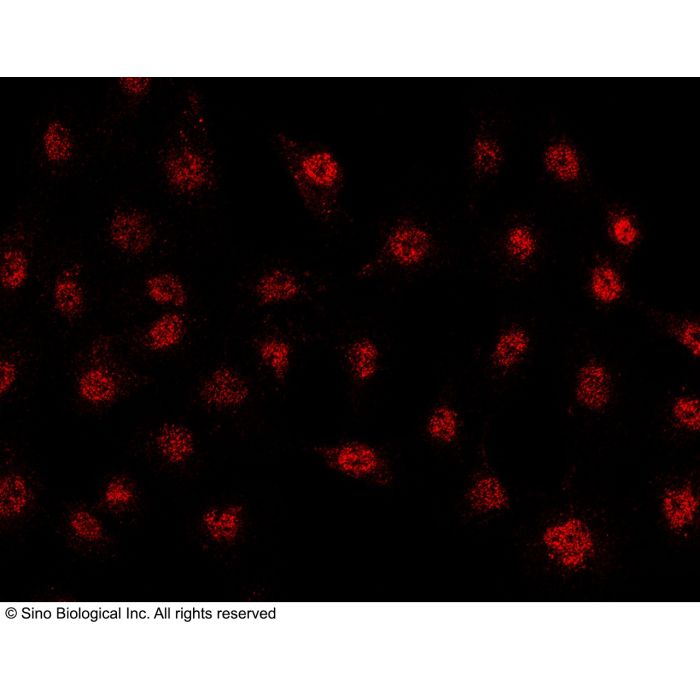
Immunofluorescence staining of FOSL1 in A431 cells. Cells were fixed with 4% PFA,blocked with 10% serum, and incubated with rabbit anti-human FOSL1 polyclonal antibody (1 µg/ml) at 4℃ overnight. Then cells were stained with the Alexa Fluor®594-conjugated Goat Anti-rabbit IgG secondary antibody (red). Positive staining was localized to nucleus.
Immunofluorescence staining of FOSL1 in A431 cells. Cells were fixed with 4% PFA,blocked with 10% serum, and incubated with rabbit anti-human FOSL1 polyclonal antibody (1 µg/ml) at 4℃ overnight. Then cells were stained with the Alexa Fluor®594-conjugated Goat Anti-rabbit IgG secondary antibody (red). Positive staining was localized to nucleus.
Immunofluorescence staining of FOSL1 in A431 cells. Cells were fixed with 4% PFA,blocked with 10% serum, and incubated with rabbit anti-human FOSL1 polyclonal antibody (1 µg/ml) at 4℃ overnight. Then cells were stained with the Alexa Fluor®594-conjugated Goat Anti-rabbit IgG secondary antibody (red). Positive staining was localized to nucleus.
Fosl1 may be used to reprogram ES cells into differentiated cell types in trophoblast lineage, which not only enhances our knowledge of global trophoblast gene regulation but also may provide a future therapeutic tool for generating induced trophoblast cells from patient-derived pluripotent stem cells.


-HD09FE2413-1ug-A431-IF.png)
-HD09FE2413-IP.png)
-HD09FE2413-WB.png)