Recombinant Human Insulin / INS Protein (Catalog#11038-HNAY)
Preparation
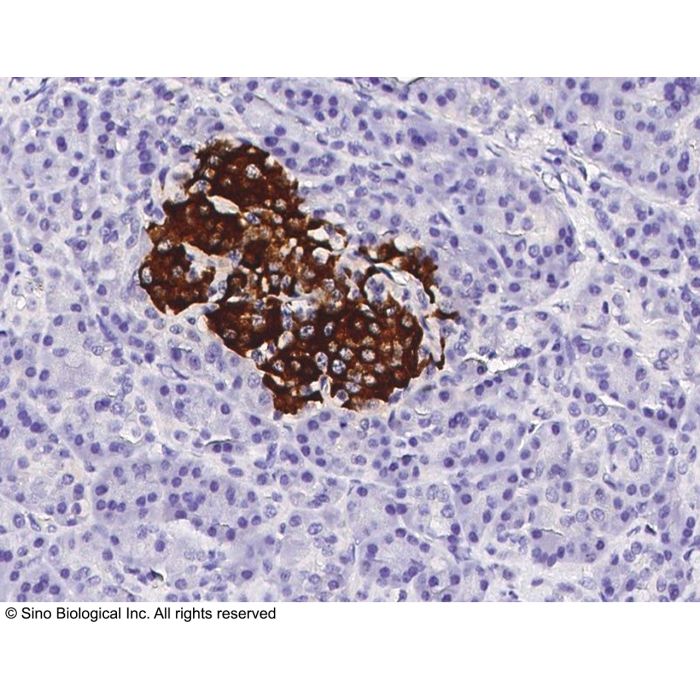
Produced in rabbits immunized with purified, recombinant Human Insulin / INS (rh Insulin / INS; Catalog#11038-HNAY; P01308; Phe25-Lys53 & Gly90-Asn110). Insulin / INS specific IgG was purified by Human Insulin / INS affinity chromatography.
Source
Polyclonal Rabbit IgG
Purification
Protein A & Antigen Affinity
Formulation
0.2 μm filtered solution in PBS
Conjugate
Unconjugated
Form
Liquid
Shipping
This antibody is shipped as liquid solution at ambient temperature. Upon receipt, store it immediately at the temperature recommended below.
Storage
This antibody can be stored at 2℃-8℃ for one month without detectable loss of activity. Antibody products are stable for twelve months from date of receipt when stored at -20℃ to -80℃. Preservative-Free. Avoid repeated freeze-thaw cycles.
INS (Insulin) is a Protein Coding gene. This gene encodes insulin, a peptide hormone that plays a vital role in the regulation of carbohydrate and lipid metabolism. After removal of the precursor signal peptide, proinsulin is post-translationally cleaved into three peptides: the B chain and A chain peptides, which are covalently linked via two disulfide bonds to form insulin, and C-peptide. The binding of insulin to the insulin receptor (INSR) stimulates glucose uptake. Diseases associated with INS include Hyperproinsulinemia and Maturity-Onset Diabetes Of The Young, Type 10. A multitude of mutant alleles with phenotypic effects has been identified, including insulin-dependent diabetes mellitus, permanent neonatal diabetes mellitus, maturity-onset diabetes of the young type 10, and hyperproinsulinemia.
Related Pathways
AMPK Signaling Pathway
Autophagy Pathway
Tags
Cancer Immunotherapy
Immune Checkpoint
Immunotherapy
Targeted Therapy
References
Veedfald S, Plamboeck A, Deacon C F, et al. Cephalic phase secretion of insulin and other enteropancreatic hormones in humans[J]. American Journal of Physiology-Gastrointestinal and Liver Physiology, 2016, 310(1): G43-G51.


-HD09OC2105-1ug-pancreas-IHC-P.png)