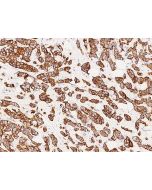
Human IL1RAP/IL-1RAcP No cross-reactivity in ELISA with Human cell lysate (293 cell line)
Immunogen
Recombinant Human IL-1RAcP / IL-1R3 protein (Catalog#10121-H08H)
Preparation
This antibody was produced from a hybridoma resulting from the fusion of a mouse myeloma with B cells obtained from a mouse immunized with purified, recombinant Human IL-1RAcP / IL-1R3 (rh IL-1RAcP / IL-1R3; Catalog#10121-H08H; NP_002173.1; Met1-Glu359). The IgG fraction of the cell culture supernatant was purified by Protein A affinity.
Source
Monoclonal Mouse IgG1 Clone #04
Purification
Protein A
Formulation
0.2 μm filtered solution in PBS with 10% Trehalose, 0.02% Tween 80, pH7.0
Conjugate
Unconjugated
Form
Liquid
Shipping
This antibody is shipped as liquid solution at ambient temperature. Upon receipt, store it immediately at the temperature recommended below.
Storage
This antibody can be stored at 2℃-8℃ for one month without detectable loss of activity. Antibody products are stable for twelve months from date of receipt when stored at -20℃ to -80℃. Preservative-Free. Avoid repeated freeze-thaw cycles.
Interleukin-1 receptor accessory protein (IL-1RAcP) also known as Interleukin-1 receptor member 3 (IL-1R3) is a cytokine receptor that binds interleukin 1. The IL-1 receptor accessory protein (IL1RAP) is a transmembrane protein that interacts with IL-1R and is required for IL-1 signal transduction. Interleukin 1 induces the synthesis of the acute phase and proinflammatory proteins during infection, tissue damage, or stress, by forming a complex at the cell membrane with an interleukin 1 receptor and an accessory protein. IL-1RAcP/IL-1R3 is a necessary part of the interleukin 1 receptor complex which initiates signaling events that result in the activation of interleukin 1-responsive genes. Alternative splicing of this gene results in two transcript variants encoding two different isoforms, one membrane-bound and one soluble. The ratio of soluble to membrane-bound forms increases during acute-phase induction or stress. IL-1RAcP/IL-1R3 mediates interleukin-1-dependent activation of NF-kappa-B. Isoform 1 is part of the membrane-bound form of the IL-1 receptor. Signaling involves the formation of a ternary complex containing IL1R1, TOLLIP, MYD88, and IRAK1 or IRAK2. Isoform 2 modulates the response to interleukins by associating with soluble IL1R1 and enhancing interleukin-binding to the decoy receptor.
Research Areas
Neuroinflammation
Related Pathways
IL1 signaling pathway
References
Goldbach-Mansky R, et al . (2009) Autoinflammation: the prominent role of IL-1 in monogenic autoinflammatory diseases and implications for common illnesses. J Allergy Clin Immunol. 124(6): 1141-9.
Johnston A, et al . (2011) IL-1F5, -F6, -F8, and -F9: a novel IL-1 family signaling system that is active in psoriasis and promotes keratinocyte antimicrobial peptide expression. J Immunol. 186(4): 2613-22.
Ozaki K, et al . (2001) Effect of tumor weight and tube feeding on TNF-alpha and IL-1beta mRNA expression in the brain of mice. JPEN J Parenter Enteral Nutr. 25(6): 317-22.