Recombinant Mouse MSR1 / CD204 protein (Catalog#50129-M07H)
Preparation
This antibody was obtained from a rabbit immunized with purified, recombinant Mouse MSR1 / CD204 (rM MSR1 / CD204; Catalog#50129-M07H; AAH03814.1; Trp 83-Val 354).
Source
Monoclonal Rabbit IgG Clone #004
Purification
Protein A
Formulation
0.2 μm filtered solution in PBS
Conjugate
Unconjugated
Form
Liquid
Shipping
This antibody is shipped as liquid solution at ambient temperature. Upon receipt, store it immediately at the temperature recommended below.
Storage
This antibody can be stored at 2℃-8℃ for one month without detectable loss of activity. Antibody products are stable for twelve months from date of receipt when stored at -20℃ to -80℃. Preservative-Free. Avoid repeated freeze-thaw cycles.
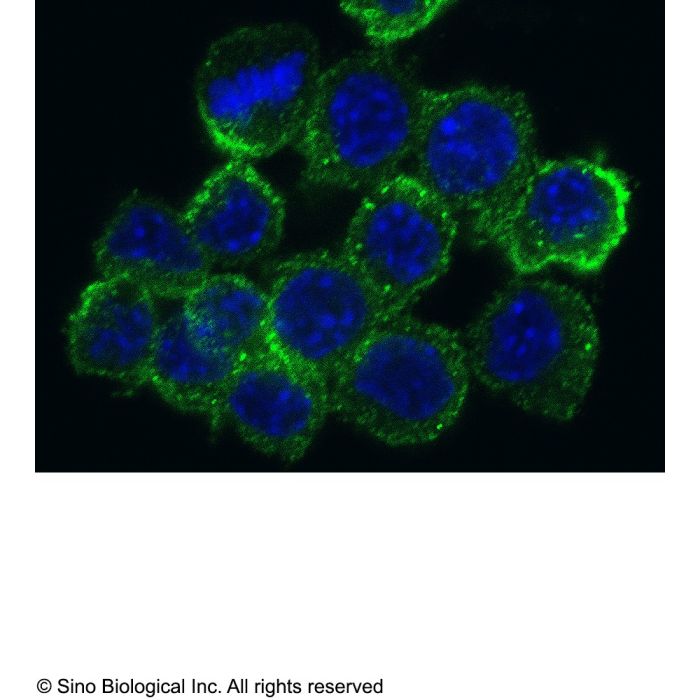
Confocal immunofluorescence analysis of Mouse MSR1 in RAW264.7 cells. Cells were fixed with 4% PFA, blocked with 10% serum, and incubated with Rabbit anti-Mouse MSR1 monoclonal antibody (1:100) at 4℃ overnight. Then cells were stained with the Alexa Fluor® 488-conjugated Goat Anti-rabbit IgG secondary antibody (green) and counterstained with DAPI (blue). Positive staining was localized to plasma membrane.
Confocal immunofluorescence analysis of Mouse MSR1 in RAW264.7 cells. Cells were fixed with 4% PFA, blocked with 10% serum, and incubated with Rabbit anti-Mouse MSR1 monoclonal antibody (1:100) at 4℃ overnight. Then cells were stained with the Alexa Fluor® 488-conjugated Goat Anti-rabbit IgG secondary antibody (green) and counterstained with DAPI (blue). Positive staining was localized to plasma membrane.
Confocal immunofluorescence analysis of Mouse MSR1 in RAW264.7 cells. Cells were fixed with 4% PFA, blocked with 10% serum, and incubated with Rabbit anti-Mouse MSR1 monoclonal antibody (1:100) at 4℃ overnight. Then cells were stained with the Alexa Fluor® 488-conjugated Goat Anti-rabbit IgG secondary antibody (green) and counterstained with DAPI (blue). Positive staining was localized to plasma membrane.
Macrophage scavenger receptor types I and II, also known as Macrophage acetylated LDL receptor I and II, Scavenger receptor class A member 1, CD24, MSR1, and SCARA1, is a single-pass type II membrane protein that contains one collagen-like domain and one SRCR domain. Macrophages are distributed in all peripheral tissues and play a critical role in the first line of the innate immune defenses against bacterial infection by phagocytosis of bacterial pathogens through the macrophage scavenger receptor 1 (MSR1). MSR1 / SCARA1 is one of the membrane glycoproteins implicated in the pathologic deposition of cholesterol in arterial walls during atherogenesis. Two types of receptor subunits exist. These receptors mediate the endocytosis of a diverse group of macromolecules, including modified low-density lipoproteins (LDL). MSR1 / SCARA1 is also involved in chronic inflammation which is a risk factor for prostate cancer. MSR1 1 gene was identified as a candidate susceptibility gene for hereditary prostate cancer and as a risk factor for sporadic prostate cancer.
References
Wang L. et al., 2003, Nat Genet. 35 (2): 128-9.
Chen Y.C. et al., 2008, Cancer Epidemiol Biomarkers Prev. 17 (4): 1001-3.
Shirato K. et al., 2009, Pflugers Arch. 459 (1): 93-103.




-R004-Purified-Raw264.7.png)