This antibody is shipped as liquid solution at ambient temperature. Upon receipt, store it immediately at the temperature recommended below.
Storage
This antibody can be stored at 2℃-8℃ for one month without detectable loss of activity. Antibody products are stable for twelve months from date of receipt when stored at -20℃ to -80℃. Preservative-Free. Avoid repeated freeze-thaw cycles.
Synonyms: Anti-Tp44 Antibody
Image / Experimental Information
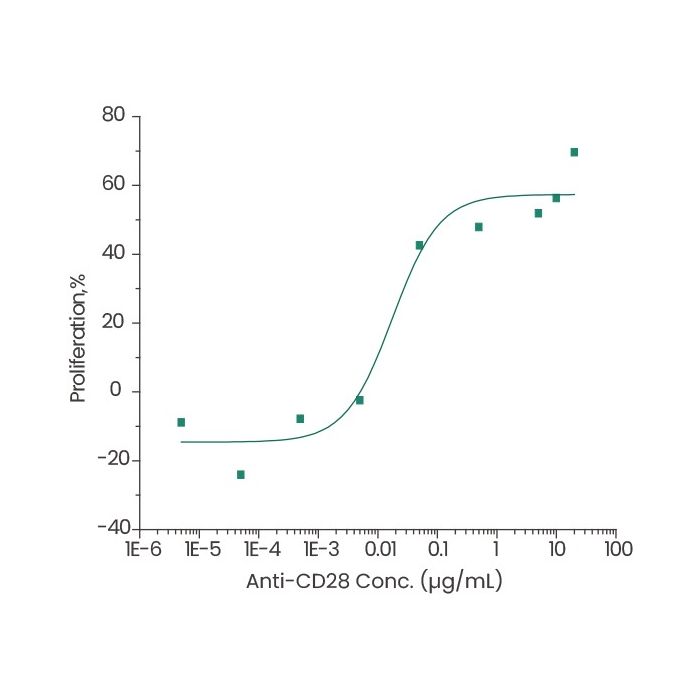
Image 1 Description
Agonist Activity – Measured by its ability to induce proliferation of human T cells. The ED 50 for this effect is typically 0.005-0.2 ug/mL.
Image 1 Alt Text
Human CD28 Functional Assay (Agonist Activity) 21062
CD28 (Cluster of Differentiation 28) is a disulphide-bonded glycoprotein belonging to the immunoglobulin (Ig) superfamily, and structurally consists of a single Ig V-like extracellular domain, a transmembrane domain and an intracellular domain. Mouse CD28 is constitutively expressed on the surface of all murine T cells and on developing thymocytes as disulfide-linked homodimers or as monomers. CD28 can binds the B7-1 and B7-2 ligand, and together perform important functions in the T and B cell response pathways. B7/CD28 family members, which can augment or antagonize T-cell receptor signaling, in the regulation of central and peripheral T-cell tolerance. CD28 is thus involved in T-cell activation, the induction of cell proliferation and cytokine production and promotion of T-cell survival.
Research Areas
ITIM/ITAM Immunoreceptors and Related Molecules
Cancer Drug Targets
Related Pathways
T Cell Receptor Signaling Pathway
Tags
Cancer Immunotherapy
Co-stimulatory Immune Checkpoint Targets
Immune Checkpoint
Immune Checkpoint Detection: Antibodies
Immune Checkpoint Detection: ELISA Antibodies
Immune Checkpoint Detection: FCM Antibodies
Immune Checkpoint Detection: IHC Antibodies
Immune Checkpoint Detection: WB Antibodies
Immune Checkpoint Targets
Immunotherapy
Targeted Therapy
References
Keir ME, et al. (2005) The B7/CD28 costimulatory family in autoimmunity. Immunol Rev. 204: 128-43.
Sansom DM, et al. (2006) The role of CD28 and cytotoxic T-lymphocyte antigen-4 (CTLA-4) in regulatory T-cell biology. Immunol Rev. 212: 131-48.
Bjrgo E, et al. (2010) Novel mechanism of signaling by CD28. Immunol Lett. 129(1): 1-6.