Produced in rabbits immunized with E. coli-derived Human MYCL fragment, and purified by antigen affinity chromatography.
Source
Polyclonal Rabbit IgG
Purification
Protein A & Antigen Affinity
Formulation
PBS, pH7.0 with 0.03% Proclin300
Conjugate
Unconjugated
Form
Liquid
Shipping
This antibody is shipped as liquid solution at ambient temperature. Upon receipt, store it immediately at the temperature recommended below.
Storage
This antibody can be stored at 2℃-8℃ for one month without detectable loss of activity. Antibody products are stable for twelve months from date of receipt when stored at -20℃ to -80℃. Avoid repeated freeze-thaw cycles.
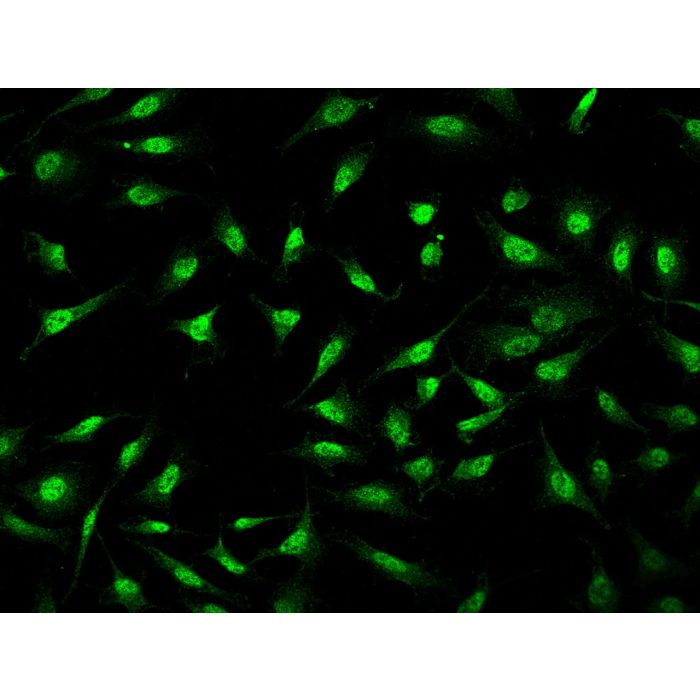
Immunofluorescence staining of MYCL in HeLa cells. Cells were fixed with 4% PFA, permeabilzed with 0.3% Triton X-100 in PBS,blocked with 10% serum, and incubated with rabbit anti-Human MYCL polyclonal antibody (dilution ratio 1:100) at 4℃ overnight. Then cells were stained with the Alexa Fluor®488-conjugated Goat Anti-rabbit IgG secondary antibody (green). Positive staining was localized to Nucleus and Cytoplasm.
All members of the MYC family are structural partners of MAX, which shares a basic helix-loop-helix (bHLH) domain and confers DNA-binding specificity to the heterodimer. The MYC family genes (MYC, MYCN and MYCL) are among the most deregulated proto-oncogenes in human cancer. Aberrant MYC expression is frequently associated with poor prognosis. MYCL (L-Myc) is frequently amplified in human small cell lung cancer (SCLC). MYCL is required by a Batf3-dependent classical dendritic cell subset (cDC1) for optimal CD8 T cell priming. MYCL is highly dynamic and might rather be a surrogate marker for disturbed energy metabolism than the underlying cause of cardiac dysfunction.
References
Wolf P, et al. (2016) Pericardial- rather than intramyocardial fat is independently associated with left ventricular systolic heart function in metabolically healthy humans. PLoS One 11 (3): e0151301.
Kim DW, et al. (2016) Genetic requirement for mycl and efficacy of rna pol i inhibition in mouse models of small cell lung cancer. Genes Dev 30 (11): 1289-1299.
Anderson DA, 3rd, et al. (2020) The mycl and mxd1 transcription factors regulate the fitness of murine dendritic cells. Proc Natl Acad Sci U S A 117 (9): 4885-4893.