Produced in rabbits immunized with E. coli-derived Human MYH11 fragment, and purified by antigen affinity chromatography.
Source
Polyclonal Rabbit IgG
Purification
Protein A & Antigen Affinity
Formulation
PBS, pH7.0 with 0.03% Proclin300
Conjugate
Unconjugated
Form
Liquid
Shipping
This antibody is shipped as liquid solution at ambient temperature. Upon receipt, store it immediately at the temperature recommended below.
Storage
This antibody can be stored at 2℃-8℃ for one month without detectable loss of activity. Antibody products are stable for twelve months from date of receipt when stored at -20℃ to -80℃. Avoid repeated freeze-thaw cycles.
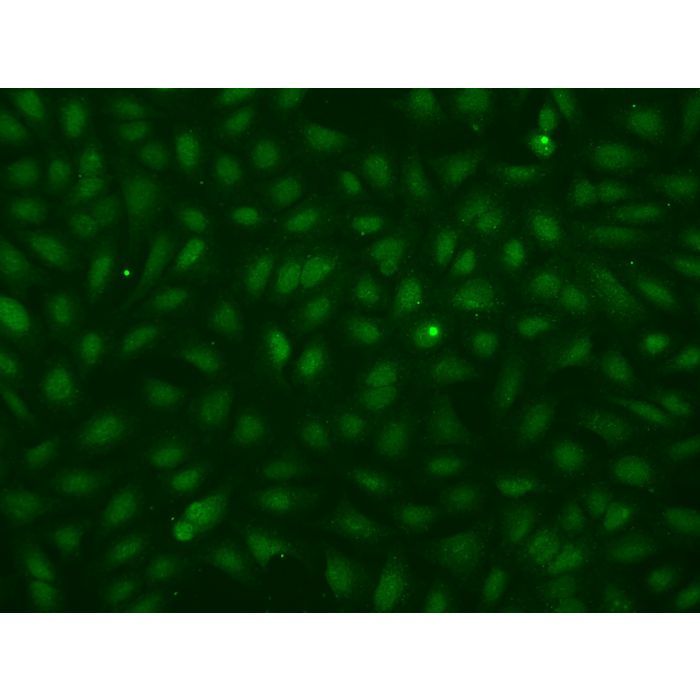
Immunofluorescence staining of MYH11 in U2OS cells. Cells were fixed with 4% PFA, permeabilzed with 0.1% Triton X-100 in PBS,blocked with 10% serum, and incubated with rabbit anti-Human MYH11 polyclonal antibody (dilution ratio 1:200) at 4℃ overnight. Then cells were stained with the Alexa Fluor®488-conjugated Goat Anti-rabbit IgG secondary antibody (green). Positive staining was localized to Nucleus.
The MYH11 gene may be related to cell migration and adhesion, intracellular transport, and signal transduction. MYH11 functions as a contractile protein, converting chemical energy into mechanical energy through adenosine triphosphate hydrolysis.MYH11 (also known as SMMHC) encodes the smooth-muscle myosin heavy chain, which has a key role in smooth muscle contraction. Inversion at the MYH11 locus is one of the most frequent chromosomal aberrations found in acute myeloid leukemia. Mutations in myosin heavy chain (MYH11) cause autosomal dominant inheritance of thoracic aortic aneurysms and dissections. At the same time, rare, nonsynonymous variants in MYH11 that are predicted to disrupt protein function but do not cause inherited aortic disease are common in the general population. The human smooth muscle myosin heavy chain locus (MYH11) was mapped by fluorescence in situ hybridization to the middle of the p arm of chromosome 16 using a genomic cosmid clone containing coding sequences of the gene as probe.




-HD12AU2110-200-U2OS-IF.png)